
Are Solar Panels Worth It in New Zealand?

For most NZ homeowners with a power bill over $200/month and a north-facing roof, solar panels are comfortably worth it. You'll typically pay back the system in 6 to 8 years, then enjoy 15 to 20+ years of near-zero electricity costs. The maths gets even better as power prices keep climbing.
PS We connect you with vetted solar installers across NZ. Answer a few quick questions, get your personalised estimate, and compare quotes.
Key Takeaways
- Payback period: 6 to 8 years for solar only, 7 to 10 years with a battery
- Annual savings: $1,500 to $2,500/yr for the average NZ household
- Self-consumption is king: every kWh you use yourself saves 30 to 38c. Exporting earns you only 7 to 23c
- Property value boost: a quality solar system can increase your home's resale value
- Even cloudy NZ works: Invercargill gets more solar irradiance than Germany, the world's 4th largest solar market
The Short Answer
Yes, for most New Zealand homeowners, solar panels are worth it. Not because we're trying to sell you anything (we're not an installer), but because the numbers genuinely stack up in 2026.
Here's the quick version: a typical 6.6kW system costs around $14,000 installed. It generates roughly 8,500 to 9,900 kWh per year depending on your region. If you use most of that power yourself (rather than exporting it back to the grid), you'll save around $2,000 to $2,500 a year on electricity. That means you break even in about 6 years, and then you've got 20+ years of panels still producing power with no ongoing cost.
But "most homeowners" isn't "all homeowners." There are situations where solar doesn't make sense, and we'll cover those honestly too. If you're renting, your power bill is tiny, or your roof faces due south, keep reading before making any decisions.
A well-sized solar system doesn't just pay for itself. It pays for itself and then keeps saving you money for another 15 to 20 years.
How Solar Saves You Money
There are two ways solar puts money back in your pocket. Understanding the difference between them is probably the single most important thing in this entire guide.
Self-consumption: the big win
Every kilowatt-hour your panels generate that you use in your home is a kilowatt-hour you don't have to buy from your power company. In NZ right now, retail electricity costs between 30c and 38c per kWh depending on your region and retailer. That's what you save per kWh of self-consumption.
This is where the real value lives. If your system generates 9,000 kWh a year and you use 70% of that yourself, you're saving around $2,080 at an average rate of 33c/kWh. That's real money off your bill every single month.
Export (buy-back): the smaller win
The electricity you generate but don't use gets fed back into the grid, and your retailer pays you for it. This is called the buy-back rate (or feed-in tariff), and it ranges from about 7c/kWh to 23c/kWh depending on which retailer you're with.
See the problem? You're selling at 7 to 23c what you'd otherwise buy at 30 to 38c. The gap between those two numbers is why everyone in the solar industry talks about "maximising self-consumption." It's not jargon for the sake of it. It genuinely makes or breaks your return.
- Run your dishwasher, washing machine, and dryer during the day when panels are producing
- Set your hot water cylinder to heat during solar hours (your installer can set this up)
- Charge your EV during the day if you work from home or have a smart charger with solar diversion
- Consider a battery to store daytime generation for evening use
Think of it this way. Your solar panels are like a little power station on your roof. Every kWh they make that you use at home saves you about 33c. Every kWh they make that you send to the grid earns you about 12c.
The maths in plain English
So you want to use as much as possible in-house, and export as little as possible.
Most NZ households without a battery self-consume around 30 to 50% of their solar generation. With a battery, that jumps to 70 to 90%. With smart load shifting (timers on hot water, appliances running during the day), you can push it to 50 to 70% even without a battery.
Real Payback Numbers for NZ
Let's work through a realistic example using 2026 NZ data. No cherry-picked scenarios, no best-case fantasy numbers. Just what a typical household actually sees.
Worked example: 6.6kW system
This is the most popular system size in NZ. It suits a 3 to 4 bedroom home using 7,000 to 9,000 kWh per year.
| Metric | Value |
|---|---|
| System cost | $14,000 installed (mid-range Tier 1 panels, string inverter) |
| Annual generation | 8,500 to 9,900 kWh (depending on region and roof orientation) |
| Self-consumption rate | 70% (with smart load shifting or a battery) |
| Self-consumed savings | 6,650 kWh x 33c = $2,195/yr |
| Exported revenue | 2,850 kWh x 12c = $342/yr |
| Total annual benefit | Roughly $2,400 to $2,500/yr |
| Payback period | $14,000 / $2,400 = approximately 5.8 years |
After payback, your panels keep producing for another 19+ years (panels are warranted 25 years, real-world lifespan is 30+). That's 19 years of near-zero electricity costs. Even accounting for an inverter replacement around year 12 ($1,500 to $3,000), the lifetime savings are substantial.
Without smart load shifting
If you're out of the house during the day and don't use timers or a battery, your self-consumption rate drops to around 30 to 40%. That changes the picture:
| Metric | Value |
|---|---|
| Self-consumed savings | 2,850 kWh x 33c = $941/yr |
| Exported revenue | 6,650 kWh x 12c = $798/yr |
| Total annual benefit | Roughly $1,740/yr |
| Payback period | Approximately 8 years |
Still worth it. Just not as compelling. This is why we always recommend thinking about how you'll use your solar power before you buy it.
Payback by system type
| System type | Payback | Notes |
|---|---|---|
| Solar only (5 to 6kW) | 6 to 8 years | Fastest payback, simplest setup |
| Solar + battery | 7 to 10 years | Batteries add cost but increase self-consumption dramatically |
| After payback | 15 to 20+ years | Near-zero electricity costs |
When Solar is Absolutely Worth It
Solar makes the most financial sense when several of these factors line up. You don't need all of them, but the more boxes you tick, the better your return.
Your power bill is over $200/month
This is the single biggest indicator. If you're spending $200+ per month on electricity, you've got enough consumption to put a solar system to work. The higher your bill, the more solar saves you, because more of that generation gets consumed on-site rather than exported at a lower rate.
You have a north-facing roof (or east/west split)
In the southern hemisphere, north-facing panels get the most sun. A north-facing roof at a 20 to 35 degree pitch is the ideal setup. But don't rule yourself out if your roof faces east or west. An east/west split system (panels on both sides) actually generates more consistent power throughout the day, even if the peak output is lower. In many cases, east/west setups achieve better self-consumption rates because they produce more in the morning and evening when you're home.
You're home during the day (or have an EV to charge)
Working from home? Retired? Have kids at home? You'll naturally use more power during peak solar hours. If you've got an EV, you can set it to charge from your panels during the day. That's near-zero fuel costs.
You plan to stay in the house 5+ years
With a 6 to 8 year payback, you want to be around to reap the benefits on the other side. That said, even if you move in 4 to 5 years, solar adds property value (more on that below), so you likely won't lose out.
You're in a good sunshine region
Nelson, Bay of Plenty, Hawke's Bay, Marlborough, and Waikato top the list for solar generation. But here's the thing: even the cloudiest part of NZ (looking at you, Invercargill) receives more annual solar irradiance than Germany, which is the world's 4th largest solar market. NZ sunshine is genuinely underrated.
When Solar Probably Isn't Worth It
We'd love to tell you solar is perfect for everyone, but that wouldn't be honest. Here are the situations where the numbers don't work as well, or where you're better off waiting.
You're renting
This is the most straightforward dealbreaker. You can't install panels on a property you don't own (without landlord agreement, which is rare). Community solar schemes are emerging in NZ, but they're still limited. If you're renting, focus on switching to a cheaper power plan and reducing usage first.
Your power bill is under $100/month
If you're in a small flat or apartment spending less than $100/month on power, the savings from solar are modest. A small system might save $600 to $900/yr, which stretches payback to 10+ years. You could still do it, but the financial case is weaker.
Your roof is south-facing only
A due-south roof in NZ receives significantly less solar radiation. Panels on a south-facing roof might produce 40 to 50% less than a north-facing setup. Some installers will quote for south-facing roofs anyway, but the payback stretches so far that it rarely makes sense unless you have no other option.
Heavy shading from trees or buildings
If your roof is shaded for large parts of the day (by trees, neighbouring buildings, or hillside), your output drops significantly. A good installer will assess shading during their site visit. Microinverters or optimisers can help with partial shading, but heavy all-day shade is a non-starter.
Solar isn't for everyone. If you're renting, your bill is tiny, or your roof faces south, the numbers probably don't add up yet.
You're planning to sell within 2 to 3 years
While solar does increase property value, the premium you'll get might not fully cover the cost if you sell within the first couple of years. That said, this is less clear-cut than the other factors. Research suggests buyers increasingly value solar-equipped homes, and you'll still benefit from reduced power bills in the meantime.
Does Solar Increase Property Value?
Short answer: yes. Longer answer: by how much depends on the system quality, age, and your local market.
Research from overseas markets (notably a comprehensive US study from the Lawrence Berkeley National Laboratory) found that solar adds roughly $15,000 to $20,000 to a home's value for a standard residential system. NZ-specific data is limited, but anecdotal evidence from valuers and real estate agents points in the same direction. Solar is increasingly seen as a desirable feature by buyers, particularly as electricity prices climb.
A few factors that influence the value add:
- System age and warranty: a newer system with 20+ years of warranty remaining adds more than one nearing end-of-life
- Panel and inverter brand: Tier 1 brands (Jinko, LONGi, Canadian Solar, REC, Trina) signal quality. Buyers and valuers recognise them
- Transferable warranty: make sure your system warranty transfers to the new owner. Most do, but check
- Documentation: keep your installer paperwork, generation data, and monitoring login. A buyer who can see actual production numbers is more confident paying a premium
Think of solar like a kitchen renovation. It costs upfront, adds value to the property, and you get to enjoy the benefits while you live there.
What About Rising Electricity Prices?
This is where the solar investment case gets really interesting. NZ electricity prices have risen approximately 31% over the past five years. There's no reason to expect that trend to reverse. Grid infrastructure investment, Transmission Pricing Methodology changes, and increasing demand from EVs and heat pumps all point to continued price increases.
When you install solar, you're essentially locking in your electricity rate at $0 per kWh for the power you generate and use. Every time the grid price goes up, your savings go up too, automatically.
Let's put some rough numbers on it. If electricity prices increase by just 5% per year (which is conservative based on recent trends), then:
| Year | Grid price per kWh | Your solar cost per kWh |
|---|---|---|
| Year 1 | 33c | $0 |
| Year 5 | ~42c | $0 |
| Year 10 | ~54c | $0 |
| Year 20 | ~87c | $0 |
This escalation effect means the real payback is actually faster than the simple calculation suggests. And your savings in years 10 to 25 are dramatically higher than in year 1.
Solar panels are a hedge against electricity price rises. The more prices go up, the more your panels are worth.
Solar With vs Without a Battery
The battery question comes up in every solar conversation. Let's break it down honestly.
Solar without a battery
| Factor | Detail |
|---|---|
| Cost | $10,000 to $16,000 for a 5 to 6.6kW system |
| Self-consumption | Typically 30 to 50% (higher if you're home during the day) |
| Payback | 6 to 8 years |
| Best for | Households wanting the simplest, fastest payback |
Solar with a battery
| Factor | Detail |
|---|---|
| Cost | $22,000 to $35,000+ for solar + battery |
| Self-consumption | Typically 70 to 90% |
| Payback | 7 to 10 years |
| Best for | Maximum independence, backup power, or out during the day |
The honest take
In purely financial terms, solar-only currently delivers a faster payback than solar-plus-battery. The battery adds $8,000 to $16,000+ to your system cost but only marginally shortens the payback period because it increases your self-consumption rate.
That said, batteries are coming down in price fast. If you're on a time-of-use tariff (like Octopus Flux), a battery lets you game the rate differences throughout the day, which can significantly improve the economics. Batteries also provide backup power during outages, which has real value in rural areas or regions prone to storms.
Our recommendation: if budget is tight, start with solar only. You can add a battery later when prices drop further. If you can afford it and value independence or backup power, go for the combo. Just don't let anyone tell you a battery is essential. It's a nice-to-have, not a must-have.
The Opportunity Cost Argument
Some people argue: "Wouldn't I be better off investing that $14,000 in an index fund instead?" It's a fair question, so let's address it directly.
A $14,000 investment at 7% annual return would grow to about $27,500 after 10 years. Not bad. But here's the solar comparison: a $14,000 solar system saving $2,400/yr delivers $24,000 in savings over 10 years. With rising electricity prices factored in, the savings are likely closer to $28,000 to $30,000 over the same period.
Key differences:
- Solar savings are tax-free. You don't pay tax on money you don't spend on electricity. Investment returns are taxable
- Solar returns are predictable (the sun keeps rising). Market returns are not
- Solar protects against inflation in a way stocks don't, because it offsets a cost that rises with inflation
- Solar adds property value, so when you sell, you recoup some of the capital too
The investment comparison also misses the practical point: most people aren't choosing between solar and an index fund. They're choosing between solar and continuing to pay rising power bills. The real question isn't "could I earn more elsewhere?" but "do I want to keep paying more for electricity every year, or do I want to lock in a fixed-cost power source?"
What to Do Next
If you've read this far and you're thinking solar might be a good fit, here's the practical path forward:
- Get your last 12 months of power bills. You need to know how much you actually use. Most retailers let you download this from their app or website
- Check your roof direction. Open Google Maps, find your house, and see which way your main roof faces. North is best, east/west is good, south is a challenge
- Get 2 to 3 quotes from vetted installers. Don't just go with the first company that knocks on your door. Compare system sizes, panel brands, inverter types, and total installed prices. Look for SEANZ members
- Ask about self-consumption estimates. A good installer will model your expected self-consumption based on your usage patterns, not just quote you the biggest system they can fit
- Think about timing your big appliances. Even before installing solar, start shifting dishwasher, washing, and hot water heating to daytime. It builds the habit and maximises your return from day one
You can also use our free solar survey tool below. It takes about 2 minutes and gives you a personalised estimate based on your location, roof, and power bill. No obligation, no salespeople calling you at dinner time.
Frequently Asked Questions
How long do solar panels last?
Most solar panels come with a 25-year performance warranty, guaranteeing they'll still produce at least 80 to 85% of their original capacity. In practice, panels last 30+ years. The inverter typically needs replacing at 10 to 15 years, which costs $1,500 to $3,000. Budget for that and you're set.
Do solar panels work on cloudy days?
Yes. Solar panels generate power from light, not direct sunshine. On an overcast day, you'll still get 10 to 25% of peak output. NZ's diffuse light conditions are actually well-suited to modern panel technology. Your annual generation figure already accounts for cloudy days, rain, and winter.
Is there a government rebate for solar in NZ?
Not directly. NZ doesn't have an upfront solar rebate like Australia. However, there are green loan options at reduced interest rates (some at 0 to 1%), and programmes like EECA Warmer Kiwi Homes that may include solar in eligible upgrades. Check our solar grants and incentives guide for the full picture.
What's the best buy-back rate in NZ?
Buy-back rates range from about 7c to 23c per kWh. Octopus Energy's time-of-use plans can pay up to 40c/kWh during peak winter export times (with a battery), while Powershop offers a consistent 13c flat rate. Electric Kiwi's MoveMaster pays up to 23c at peak. The best choice depends on your setup. See our buy-back rates comparison for details.
Can I go completely off-grid in NZ?
Technically yes, but it's expensive and rarely practical for urban or suburban homes. Going fully off-grid requires a very large battery bank and backup generation. For most Kiwi households, staying grid-connected with solar (and optionally a battery) gives you the best of both worlds: cheap power during the day, grid backup at night, and export income for surplus generation.
Do I need council consent to install solar panels?
In most cases, no. Standard rooftop solar installations are a permitted activity under the Building Act and don't require a building consent, provided the panels are flush-mounted and your roof can handle the additional load (about 12 to 15kg per square metre). Your installer will check structural suitability as part of their assessment. Heritage-listed properties may have additional requirements.
What happens if I generate more than I use?
Your excess electricity flows back into the grid through your smart meter, and your retailer credits you at their buy-back rate. This appears as a credit on your power bill. In summer, when days are long and generation is high, many solar households end up with a near-zero or even negative power bill. In winter, you'll still draw from the grid in the evenings and on shorter days, so expect a reduced (but not zero) bill.
Written by Sarah Chen
Sarah has spent three years covering renewable energy in New Zealand, from residential rooftop systems to community solar projects. She holds a degree in Environmental Science from the University of Auckland.
Reviewed by
Matt Wilson
Registered Electrician & Solar Installer
Related guides
View all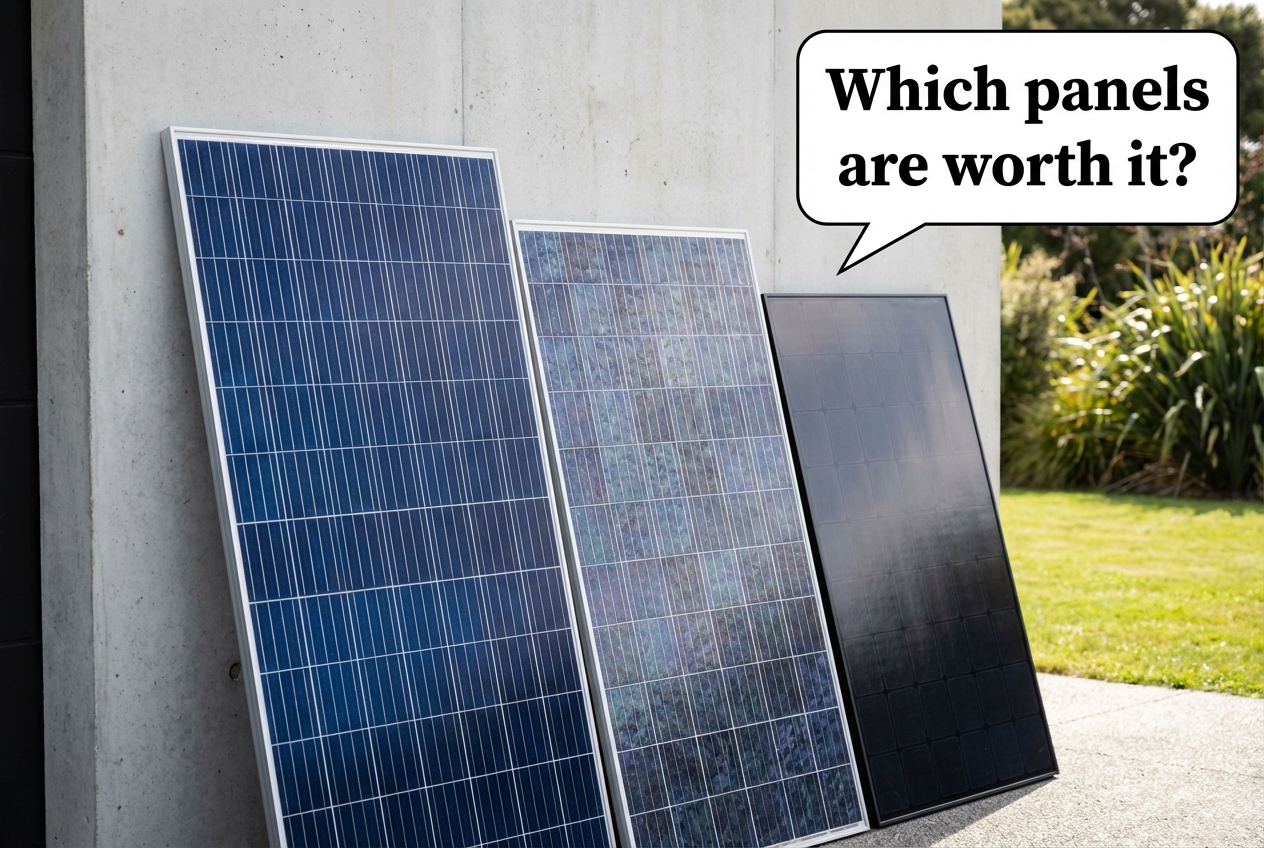
Best Solar Panels NZ: Brands, Tiers and What to Look For (2026)
Compare the best solar panels available in NZ. Tier 1 brands, specs, warranties, NZ pricing, and what installers actually use. TOPCon vs PERC vs HJT explained.
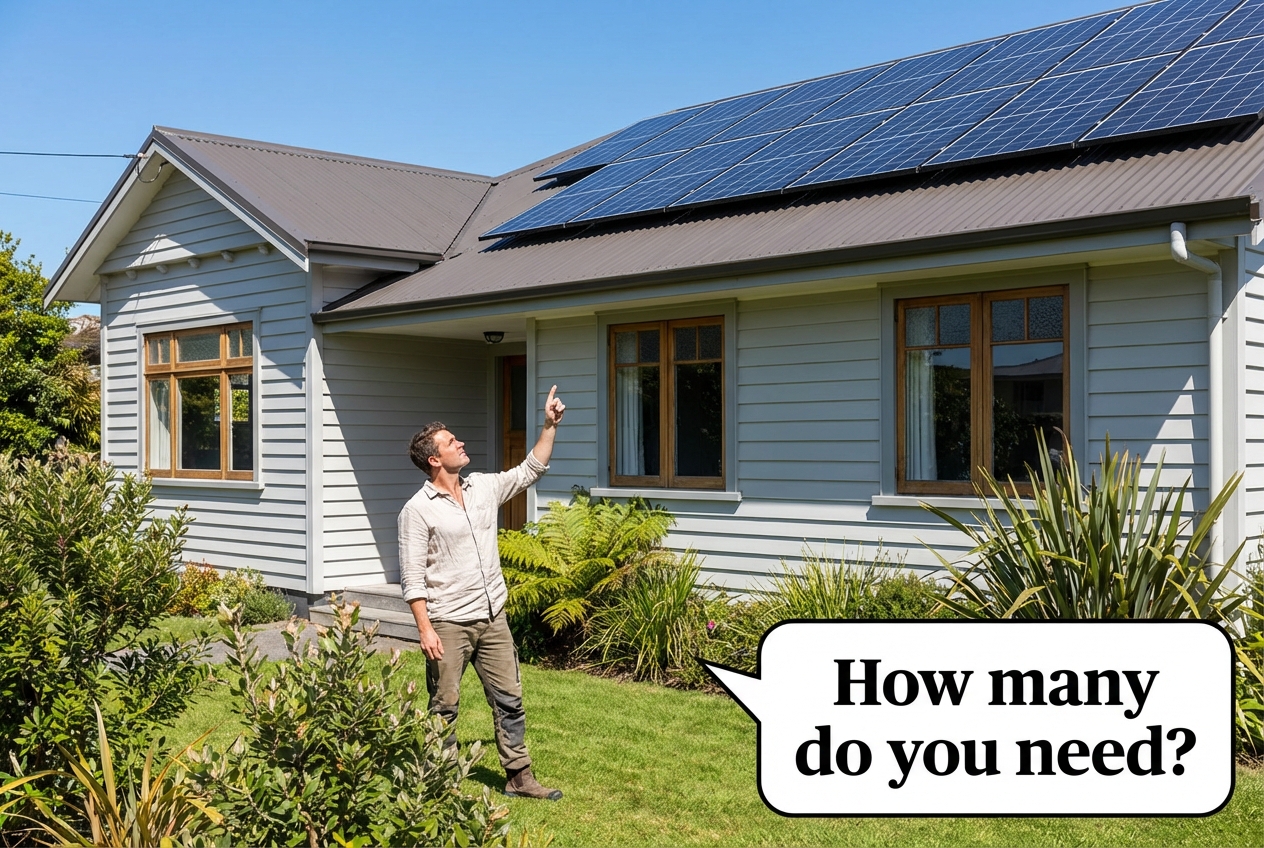
How Many Solar Panels Do I Need?
Work out how many solar panels your NZ home needs. Based on your power usage, roof space, and whether you're adding a battery or EV charger.
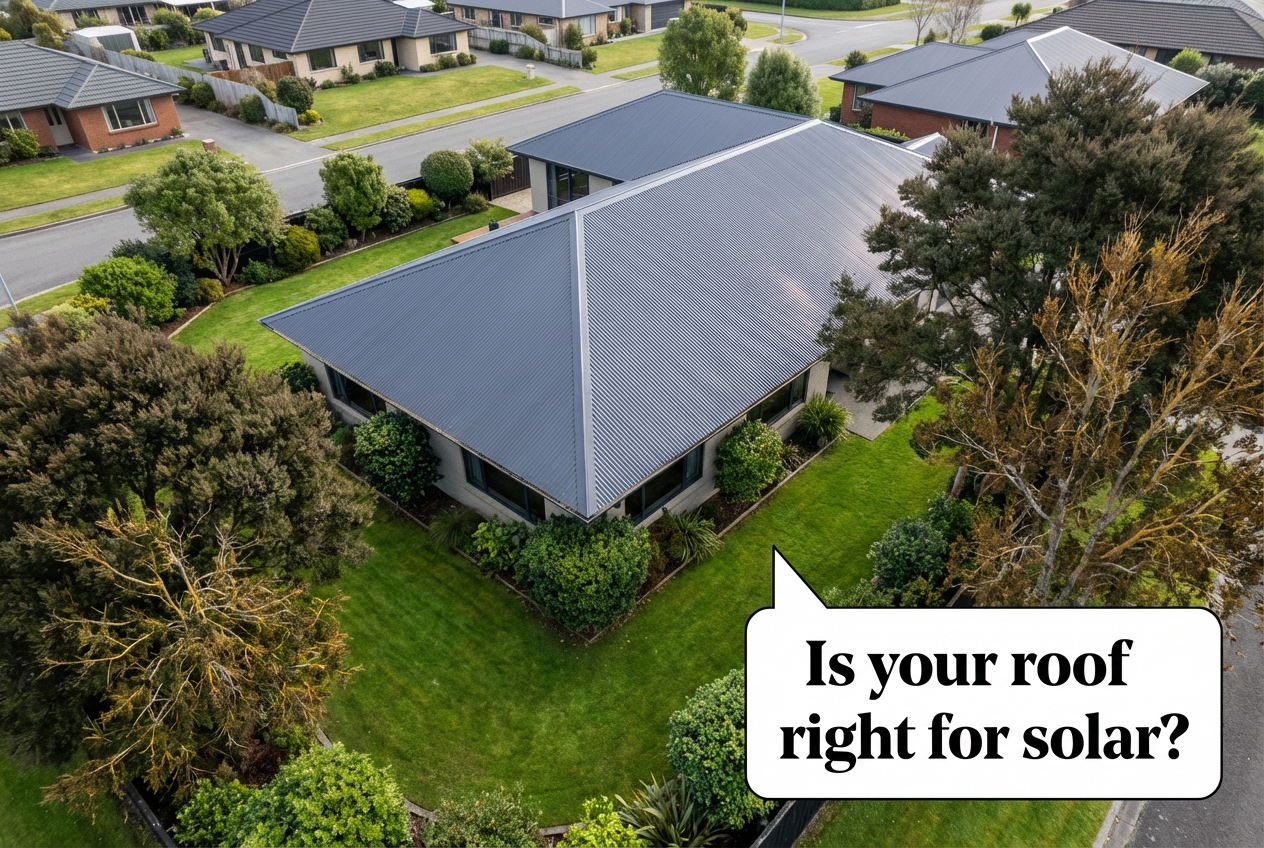
Is My House Suitable for Solar Panels?
Check if your NZ home is right for solar. Roof direction, pitch, shade, and structural factors explained for Kiwi houses.
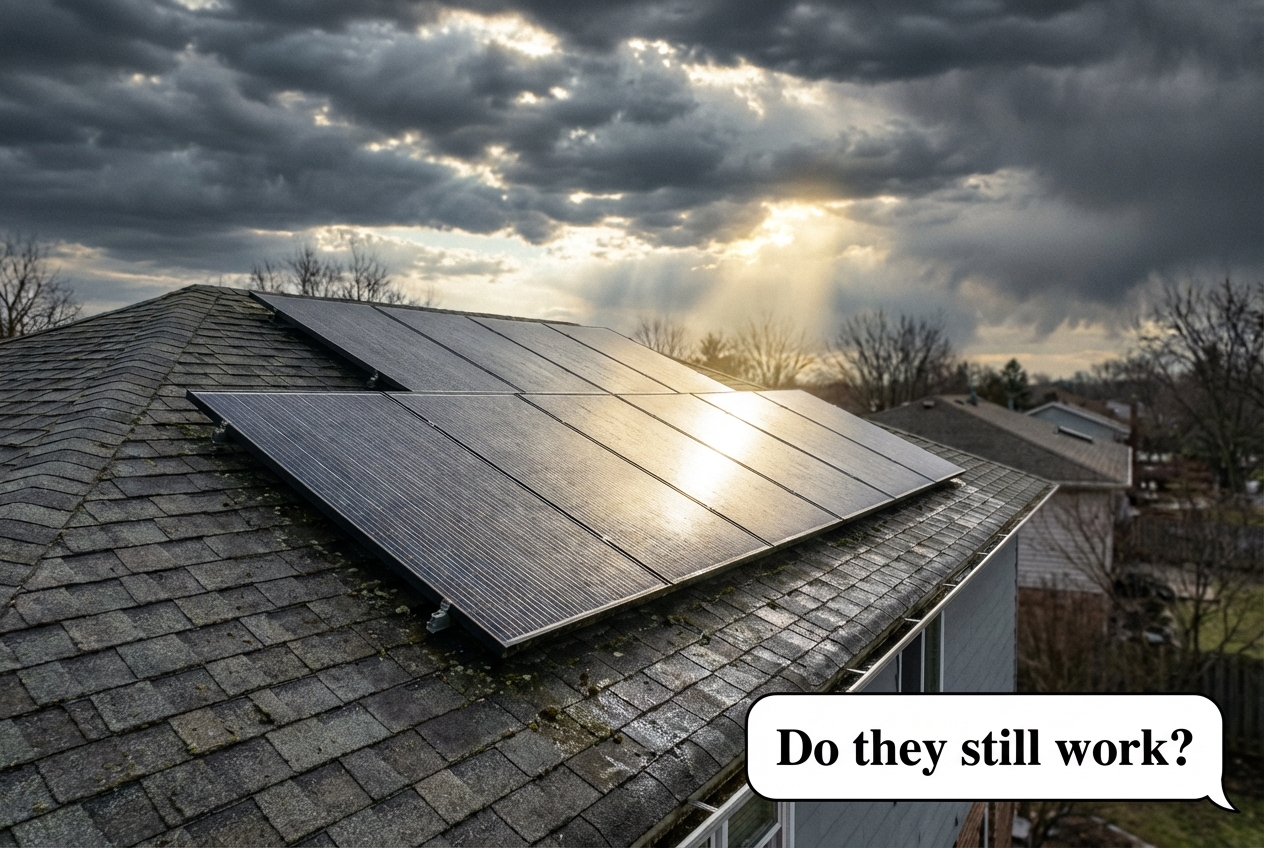
Do Solar Panels Work in Winter and on Cloudy Days in NZ?
Solar panels still generate power on cloudy days and through NZ winters. Here's exactly how much output changes and why it still works.