
Buying Solar Panels in NZ: What You Need to Know
You have read the cost guides. You have checked your roof. You are pretty sure solar makes sense. Now you are actually ready to buy, and this is where the advice gets thin. Most guides stop at "get three quotes and compare." That is fine as far as it goes, but it skips the parts that actually trip people up.
This guide covers the stuff that NZ homeowners consistently say they wish they had known before signing. Not the basics. The gotchas, the process bottlenecks, and the questions your installer probably will not bring up unless you ask.
PS We connect you with vetted solar installers across NZ. Answer a few quick questions, get your personalised estimate, and compare quotes from trusted local companies.
10 Things NZ Solar Buyers Wish They Had Known
- The meter change can take weeks and your system sits idle until it happens.
- Self-consumption percentage is the number that makes or breaks payback projections. Always ask what the installer used in their calculations. Normal is 30 to 50% without a battery. If the quote shows 100%, walk away.
- Two major NZ solar companies have collapsed in the last 18 months (SolarZero, Solar Group). Installer longevity matters.
- SEANZ certification is required for every bank green loan. No SEANZ, no 0% Westpac loan.
- Building consent is no longer needed for most residential installs since October 2025, saving about $1,060.
- Export limits (5kW) mean your excess is curtailed at the inverter. A hot water diverter uses it instead of wasting it.
- Hot water diversion pays back in about 3 years and costs $500 to $1,500. It is the best value add-on available.
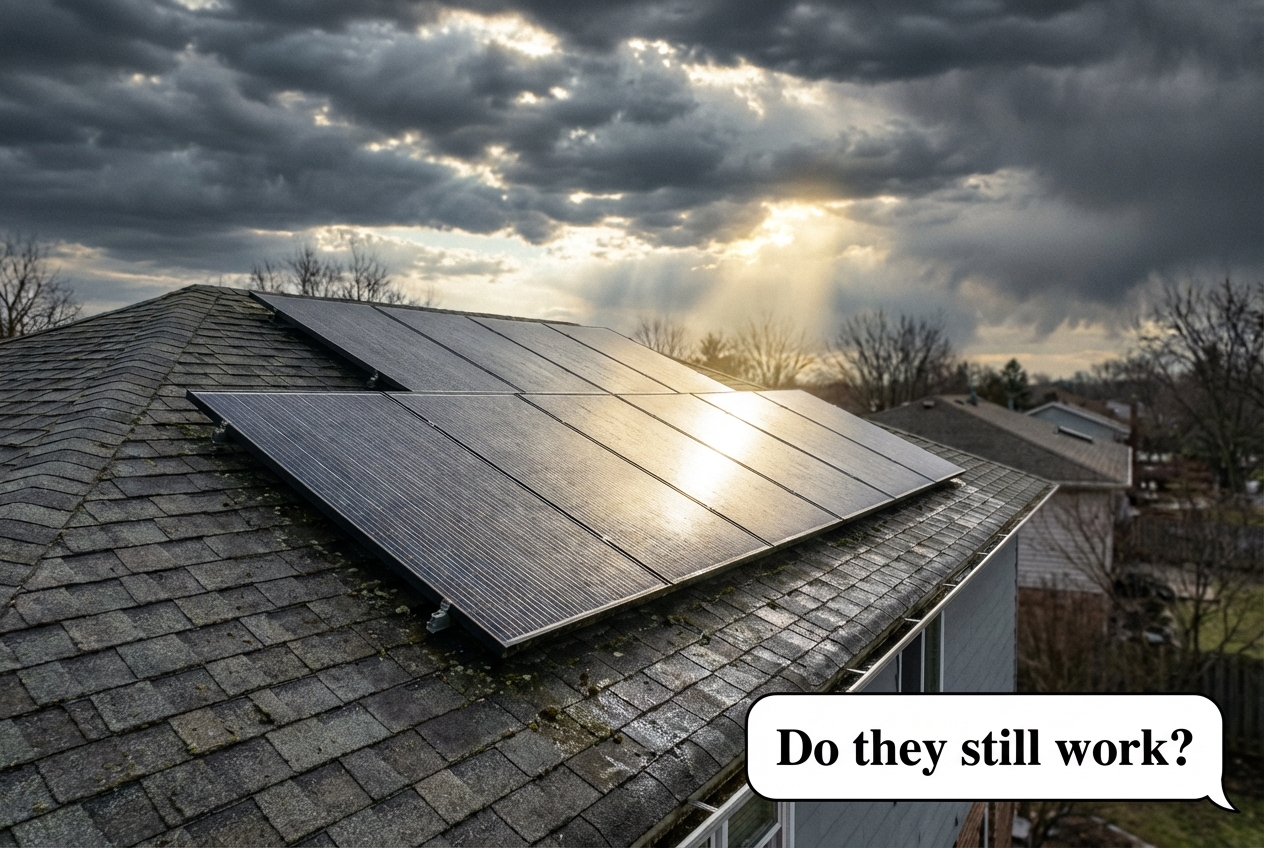
- Winter production is about a third of summer. Do not expect year-round grid independence.
- The Consumer Guarantees Act protects you even if your installer goes bust. You can claim against the manufacturer or importer.
- Nobody regrets going bigger. The universal regret is "I wish I had put on more panels."
The Buying Timeline: Quote to Panels on Roof
Most people assume solar installation is a one-day thing. The physical install often is. But the full process, from first quote to a working, exporting system, typically takes about four weeks. Here is what that looks like.
[1] Getting quotes
EECA recommends getting two to three quotes to compare. We would say three is the minimum. Some installers are excellent. Others are salespeople who have never been on a roof. The only way to tell the difference is to compare what they propose, how they explain it, and how much pressure they apply.
[2] Signing and scheduling
Once you choose an installer, expect two to four weeks before the crew shows up. Summer is the busy season, and some popular installers book out six to eight weeks ahead. A standard deposit is 10 to 20% of the total cost, with the balance due on completion.
[3] Installation day
A typical residential install takes one to two days. The crew mounts rails to your roof, fixes the panels, runs wiring to the inverter location (usually your garage or utility cupboard), and connects everything to your switchboard. The electrician then produces a Certificate of Compliance (CoC).
[4] Inspection
An independent electrical inspector visits (sometimes the same day, sometimes a few days later) and produces a Record of Inspection (ROI). Your system cannot legally be turned on until this is done.
[5] The meter change
This is the bit nobody warns you about. Your power company needs to swap your meter to an import/export smart meter. The timing is out of your installer's control. Some homeowners get it done within days. Others wait several weeks, especially during busy periods. Your system sits on the roof, fully installed, doing nothing until this happens.
Tip: Contact your power company the day you sign the installation contract and ask them to queue up the meter change. Do not wait until the panels are on the roof.
Your system is fully installed but cannot export until the meter is changed. Contact your power company early to avoid weeks of idle waiting.
Common Mistakes NZ Buyers Make
[1] Not getting enough quotes
Some installers are outstanding. Others are salespeople with limited technical knowledge who cannot answer basic questions about your roof, insist on a battery you do not need, or cannot start the install for months. Three quotes is the minimum to spot the difference.
[2] Trusting the payback projection at face value
Every solar quote includes a payback estimate. These are only as honest as the assumptions behind them. Consumer NZ caught companies setting the self-consumption rate to 100% in their quote software, which dramatically improves the projected payback. In reality, most households self-consume 30 to 50% of their solar generation without a battery. Always ask: "What self-consumption percentage did you use in this calculation?"
[3] Ignoring the inverter
Panels last 25 to 30 years. Inverters typically need replacing after 10 to 15 years. The inverter is the heart of your system and the most likely point of failure. A cheap panel with a quality inverter will outperform a premium panel with a no-name inverter. Ask about the inverter brand, warranty length, and whether it is battery-ready for future expansion.
[4] Being pressured into batteries
Some installers push batteries hard because they significantly increase the sale value. For most NZ homes in 2026, batteries do not yet make financial sense on pure payback (solar-only payback is 6 to 8 years, adding a battery extends it to 10 to 15 years). Batteries make sense if you value backup power, are on a time-of-use plan, or have very high evening usage. But for most people, solar panels alone are the better first investment.
[5] Going too small
The single most common regret from NZ solar owners: "I wish I had put on more panels." Nobody says the opposite. Panels are the cheapest part of the system relative to installation costs. Adding a few extra during the initial install costs far less than coming back later for a separate job. If your roof and budget allow it, go slightly bigger than your current needs.
The Self-Consumption Trick (and Other Quote Red Flags)
Consumer NZ flagged this in their investigation of the solar industry. Quote software allows installers to adjust the self-consumption percentage, which has an enormous effect on projected savings and payback period. Setting it to 100% (meaning you supposedly use every kWh you generate) makes the numbers look brilliant. But it is not realistic for any household that leaves the house during the day.
Realistic self-consumption rates:
- Without a battery: 30 to 50% (higher if someone is home during the day)
- With a hot water diverter: 45 to 65%
- With a battery: 60 to 80%
- With a battery and hot water diverter: 75 to 90%
If a quote shows 100% self-consumption without a battery, the installer is either incompetent or dishonest. Either way, get a different quote.
Always ask: "What self-consumption percentage did you use in this projection?" If the answer is above 50% and there is no battery in the quote, something is wrong.
Other red flags to watch for:
- "Sign today" pressure. Genuine installers give you time to compare.
- No site visit. A quote without physically seeing your roof is not worth the paper it is on.
- Vague brand names. "Premium tier-1 panels" without specifying the actual brand and model.
- No itemisation. Just a single total price with no breakdown of panels, inverter, mounting, and labour.
- Missing GST. Always confirm the price is GST-inclusive.
- Price dropping dramatically when you hesitate. The original price was inflated.
- Not SEANZ certified. Mandatory for bank green loans and a basic quality indicator.
What Happens if Your Installer Goes Bust?
This is not a hypothetical question. Two major NZ solar companies have gone into liquidation in the last 18 months.
SolarZero (liquidated November 2024)
NZ's largest solar provider, with roughly 15,000 customers and about 40% market share. BlackRock bought the company for $110 million in 2022, injected a further $147.8 million, and it still failed. Customers had panels and batteries on lease agreements with no upfront cost. When the company collapsed, customer contracts were transferred to trusts controlled by Public Trust, with a third-party servicing company taking over maintenance. Some customers have reported billing problems, disputes, and equipment failures. As one customer told the NZ Herald: "It feels like a liability on the roof now."
Solar Group (liquidated July 2025)
The second major collapse in eight months. Owed more than $3 million to hundreds of creditors, including Kiwibank. Failed due to cash flow constraints, declining sales, and pricing pressure. Staff terminated, business ceased trading.
How to protect yourself:
- Own your panels outright. Avoid lease and power purchase agreements where you do not own the equipment. SolarZero's model left customers trapped.
- Check SEANZ membership. Not a guarantee of survival, but adds accountability.
- Verify the panel brand has NZ-based warranty support. Ask who the local distributor or importer is.
- Avoid grey imports. If panels were sourced outside authorised channels, the manufacturer may refuse to honour the warranty.
- Keep all documentation. Certificate of Compliance, Record of Inspection, warranty cards, invoices, and system design specs.
- Know your Consumer Guarantees Act rights. You can claim against the manufacturer or importer, not just the installer. This is law, and it sits on top of any express warranty.
A 25-year panel warranty is worthless if your installer folds in 3 years. Check who actually backs the warranty: the manufacturer, the importer, or just the installer.
SEANZ, Green Loans, and Why They're Connected
Every major NZ bank offering a green or sustainable energy loan requires your installer to be a SEANZ (Sustainable Energy Association of New Zealand) member. This is non-negotiable. If your installer is not SEANZ certified, you cannot access any of these rates.
| Bank | Rate | Max | Term |
|---|---|---|---|
| Westpac | 0% | $50,000 | 5 years |
| ANZ | 1% p.a. | $80,000 | 3 years |
| ASB | 1% p.a. | $80,000 | 3 years |
| BNZ | 1% p.a. | $80,000 | 3 years |
| Kiwibank | Standard + $2k cashback | $5,000+ | 4 years |
The Westpac deal is the standout: genuinely 0% interest for five years on up to $50,000. The catch is you must pay it off within five years or a default rate of 5% kicks in. Most of the other banks require an existing mortgage with them, as the green loan is typically structured as a mortgage top-up.
New Zealanders have borrowed over $1 billion in green loans for heat pumps, solar, EVs, and home energy improvements. The infrastructure for financing solar is solid. You just need a SEANZ installer to access it.
Building Consent: What Changed in October 2025
Good news. Changes to Schedule 1 of the Building Act on 23 October 2025 mean that most residential solar installations no longer need building consent. This saves homeowners about $1,060 in consent fees and eliminates processing delays.
- Under 40m2 total array area, standard wind zone: No consent needed. This covers the vast majority of residential installs (a typical 6.6kW system with 15 panels is about 30m2).
- Over 40m2 or high wind zone: No consent needed, but the structural fixings must be designed or reviewed by a Chartered Professional Engineer (CPEng).
- Solar panels used as roof cladding (replacing tiles/iron, not sitting on top): Still needs consent.
- Heritage or design-sensitive zones: May need resource consent from your local council.
One related change to be aware of: from 1 September 2026, any grid-connected solar must be installed by an electrician holding a Mains Parallel Generation Systems endorsement. This was originally set for September 2025 but was extended by 12 months to allow electricians time to complete the required training. Make sure your installer is qualified.
The Meter Change Bottleneck
This catches almost every new solar owner off guard. Your system is installed, inspected, and ready to go. But it cannot export power to the grid until your power company swaps your meter to an import/export smart meter. The cost is about $127, and it is arranged by your power company (not your installer). The problem is timing: it is entirely out of your installer's control.
Some homeowners report same-week meter changes. Others wait several weeks, particularly during summer when installations peak. During this time, your system can power your house in real time but cannot export anything. Any excess generation is simply curtailed.
What to do: Contact your power company the moment you sign the installation contract. Tell them the expected installation date and ask them to schedule the meter change for as close to that date as possible. If you already have a smart meter, it may only need reconfiguring rather than physical replacement, which is faster.
Hot Water Diversion: The Best Add-On Nobody Mentions
A solar diverter takes excess energy that would otherwise be exported at your buy-back rate (typically 8 to 12c/kWh) and redirects it to heat your hot water cylinder. Since retail electricity costs 30c+ per kWh, every diverted kWh saves you 18 to 22c more than exporting it. Contact Energy ran a trial and found that up to 38% of solar electricity generated could be used to heat the cylinder.
- Cost: $500 to $1,500 installed
- Payback: About 3 years
- Works with: Standard electric hot water cylinders only
- Does NOT work with: Heat pump hot water systems (they need steady power, not the variable trickle a diverter provides)
- Popular NZ brands: SunStash, Green Catch
A hot water diverter is essentially a cheap thermal battery. For $500 to $1,500 you get most of the benefit of a $14,000 battery system, at least for hot water. If you are installing solar and you have a standard electric hot water cylinder, this should be at the top of your add-on list.
A $1,000 hot water diverter pays for itself in about 3 years. A $14,000 battery takes 10 to 15 years. For pure economics, the diverter wins by a wide margin.
String vs Micro vs Hybrid: Choosing Your Inverter
The inverter converts your panels' DC electricity into the AC power your home uses. There are three main types, and the right choice depends on your roof and your plans.
String inverters (Fronius, SMA, Sungrow)
One central inverter handles all your panels. This is the cheapest option and works well for simple roofs with minimal shading. Modern models have multiple MPPT trackers that handle partial shade reasonably well. The downside: if the inverter fails, your entire system goes down. Typical warranty is 5 to 10 years, extendable to 15 or 20. Fronius is the most popular brand in NZ, with local support and fast replacement turnaround.
Microinverters (Enphase)
A small inverter on each individual panel. Each panel operates independently, which is ideal for complex roofs with multiple orientations or shading issues. You get panel-level monitoring, and one panel failing does not affect the rest. The trade-off: about 30 to 40% more expensive to install. Enphase microinverters carry a 25-year warranty, which is a significant advantage.
Hybrid inverters (Sungrow, GoodWe)
A string inverter with built-in battery management. If you are planning to add a battery now or in the near future, a hybrid inverter avoids buying a separate battery inverter later. Slightly more expensive than a standard string inverter, much less than microinverters.
A common NZ sizing note: with most EDBs limiting export to 5kW, it is standard practice to oversize your panels relative to your inverter. A 6.6kW panel array on a 5kW inverter is perfectly normal. You generate more during morning and evening hours when the sun is low, and only clip during the midday peak when you would hit the export limit anyway.
Insurance: What You Need to Tell Your Insurer
You must notify your insurer when you install solar panels. Solar panels attached to your home are covered under your home insurance policy, but only if your sum insured reflects the full value of your property including the panels. If you do not update it, you could be underinsured.
- Update your sum insured. Add the full installed cost of the system to your declared home value.
- Premium increases are usually modest. Solar panels add value to your property, which bumps the sum insured, but the premium increase is typically small.
- Insurance covers event damage (storms, fire, falling trees), not equipment failure. Equipment failure is covered by manufacturer and installer warranties.
The Warranty Landscape (and What's Actually Enforceable)
There are four separate warranties covering your solar system. Understanding which one does what saves a lot of confusion when something goes wrong.
| Warranty | Covers | Typical Length |
|---|---|---|
| Panel product | Manufacturing defects, materials | 25 years (industry standard now) |
| Panel performance | Output degradation (min 87% at 25 years) | 25 to 30 years |
| Inverter | Equipment failure | 5 to 25 years (varies by type) |
| Installer workmanship | Quality of installation, roof penetrations, wiring | 5 to 10 years |
The workmanship warranty is the most vulnerable because it dies with the installer. The panel and inverter warranties are backed by the manufacturer, which survives the installer going bust. Under New Zealand's Consumer Guarantees Act, businesses cannot limit their obligations to just the terms of a written warranty. Your CGA rights sit on top of any express warranty. If your installer folds, you can make a claim against the manufacturer or the NZ importer/distributor.
Watch out for grey imports. If panels were imported outside authorised channels, the manufacturer may refuse to honour the warranty. Always ask your installer: "Who is the authorised NZ distributor for these panels?"
What to Expect Month by Month
Your first year with solar will feel like a rollercoaster. Understanding the seasonal pattern stops the mid-winter panic.
- December to February: Peak production. Your system will generate more than you use on most days. This is when solar feels amazing.
- March to May: Production drops noticeably. You will start drawing more from the grid, especially in the evenings.
- June to July: The low point. A 6kW system might only produce 8 to 12 kWh per day, compared to 25 to 30 in summer. This is normal.
- August: Recovery begins. Production picks up and the days get noticeably longer.
- September to November: Ramping back to full production. By November you are back to generating more than you use.
On average, summer generation is about 47% higher than winter. The rough rule: winter production is about a third of summer. If you are in Southland, it can drop to as low as 2 peak sun hours per day in June. Further north, you will fare better, but the seasonal swing is real everywhere in New Zealand.
This is why solar is sized for annual production against annual consumption. Summer surplus compensates for the winter deficit. Think of it like a savings account: you deposit more in summer and draw down in winter.
What to Do Next
You now know more about buying solar in NZ than 95% of people who sign a contract. Here is how to put that knowledge to work.
Frequently Asked Questions
How long does the whole process take from first quote to working system?
Typically about four weeks from signing to a fully operational, exporting system. The physical installation takes one to two days. The rest is scheduling, inspection, and waiting for the meter change.
Do I need building consent for solar panels in NZ?
Not for most residential installations since October 2025. If your array is under 40m2 and you are in a standard wind zone, no consent is needed. Over 40m2 or in a high wind zone, you need a Chartered Professional Engineer to review the structural fixings, but still no formal consent.
What happens to my solar system if my installer goes out of business?
Your system keeps working. Panel and inverter warranties are backed by the manufacturer, not the installer. Under the Consumer Guarantees Act, you can claim against the manufacturer or NZ importer. The installer workmanship warranty is the one you lose. This is why keeping all documentation (CoC, ROI, invoices) matters.
Can I install solar panels myself in NZ?
No. Solar installation must be completed by a registered electrician. From September 2026, they will also need a specific Mains Parallel Generation Systems endorsement. DIY installation voids product warranties, invalidates insurance coverage, and will not be approved for grid connection.
Is a hot water diverter worth adding?
Almost always, if you have a standard electric hot water cylinder. At $500 to $1,500 installed with a payback of about 3 years, it is the best value add-on available. It does not work with heat pump hot water systems.
Should I get a battery at the same time as my panels?
For most NZ homeowners, panels first and battery later is the better financial decision. Solar-only payback is 6 to 8 years. Adding a battery extends that to 10 to 15 years. If you value backup power during outages or are on a time-of-use electricity plan, a battery may make sense sooner. Either way, make sure your inverter is battery-ready so you are not paying for a full rewire later.
What should I look for in a solar quote?
Panel brand, model, and wattage. Inverter brand and warranty. Total system size in kW. Itemised cost breakdown (not just a lump sum). Expected annual production. The self-consumption percentage used in payback calculations (should be 30 to 50% without a battery). Workmanship warranty length. Whether the installer is SEANZ certified. And confirmation that the price is GST-inclusive.
How much does the meter change cost?
About $127 including installation. It is arranged by your power company, not your solar installer. If you already have a smart meter, it may only need reconfiguring rather than physical replacement.
Written by Sarah Chen
Sarah has spent three years covering renewable energy in New Zealand, from residential rooftop systems to community solar projects. She holds a degree in Environmental Science from the University of Auckland.
Reviewed by
Matt Wilson
Registered Electrician & Solar Installer
Related guides
View all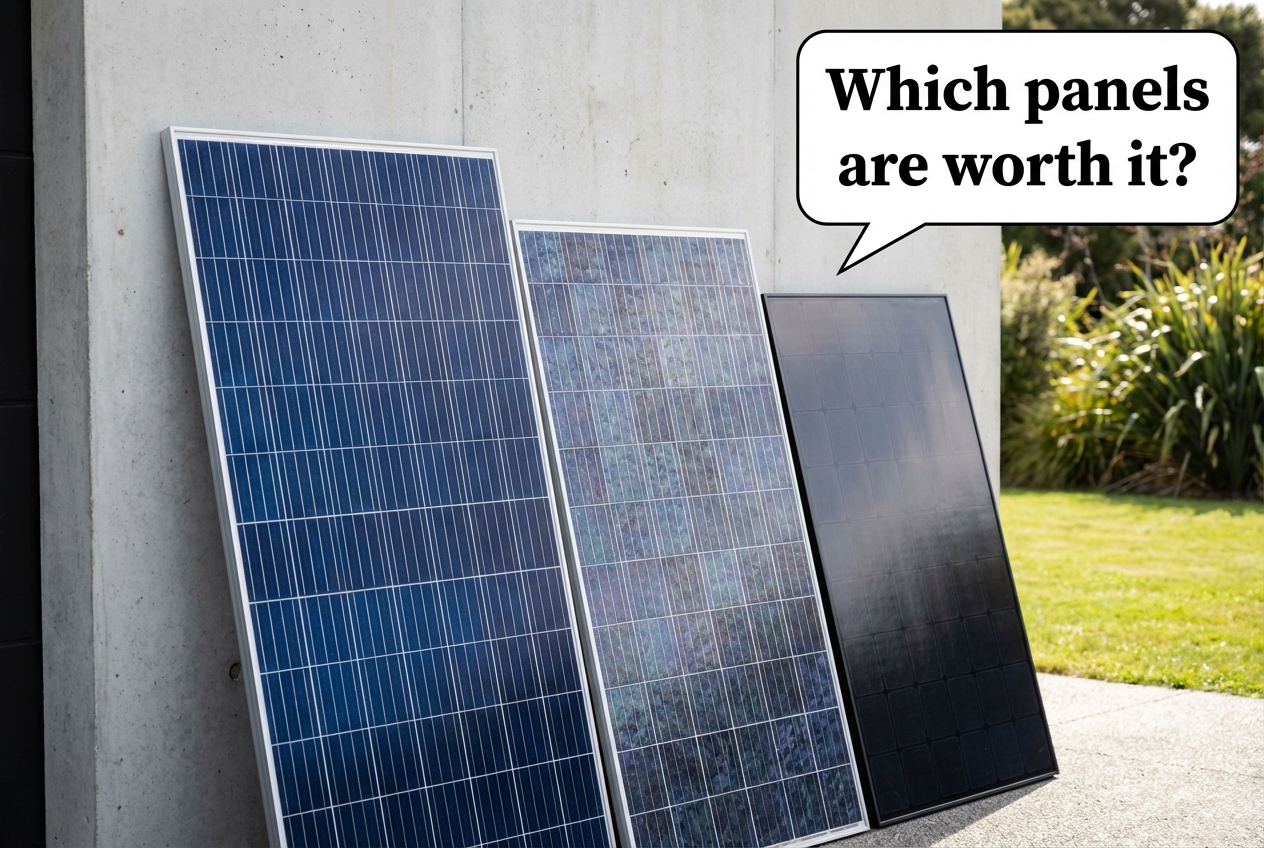
Best Solar Panels NZ: Brands, Tiers and What to Look For (2026)
Compare the best solar panels available in NZ. Tier 1 brands, specs, warranties, NZ pricing, and what installers actually use. TOPCon vs PERC vs HJT explained.
How Many Solar Panels Do I Need?
Work out how many solar panels your NZ home needs. Based on your power usage, roof space, and whether you're adding a battery or EV charger.
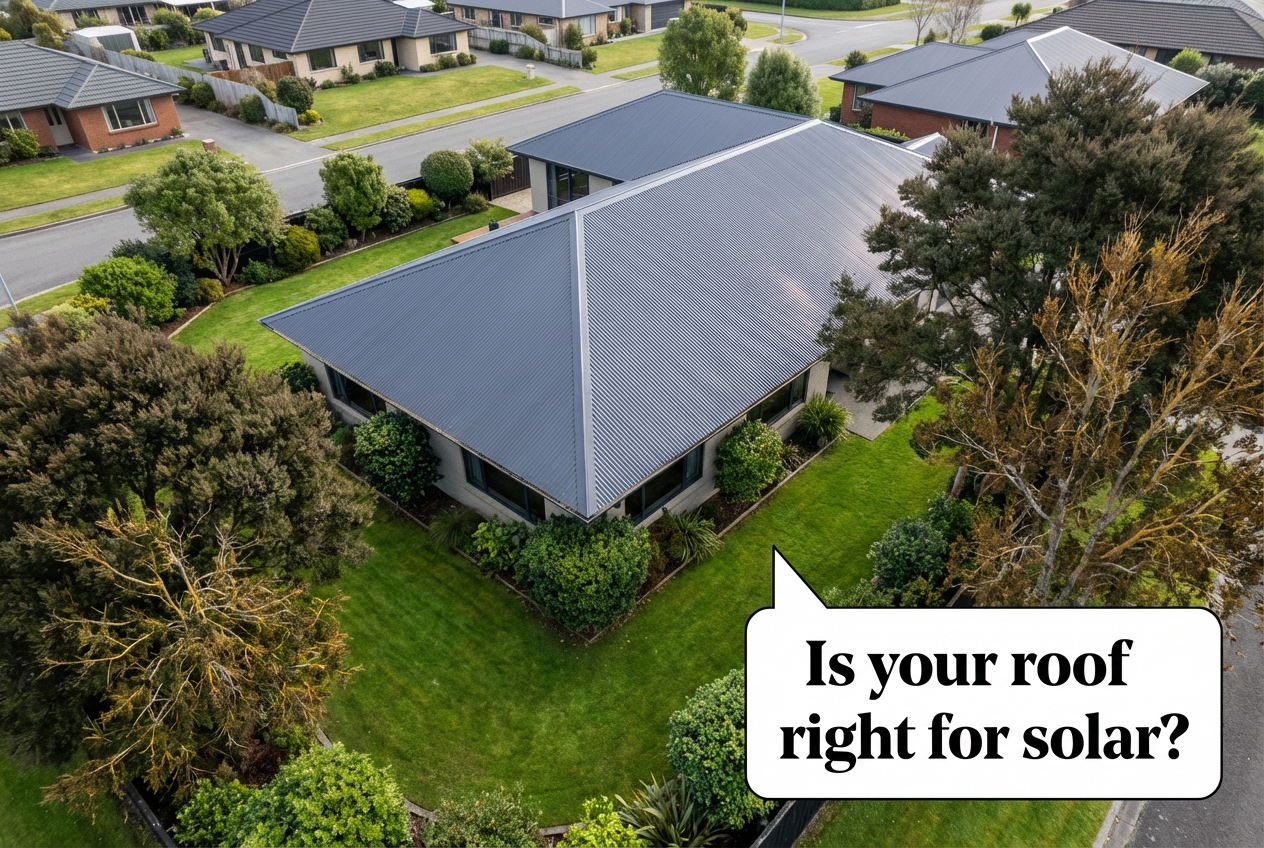
Is My House Suitable for Solar Panels?
Check if your NZ home is right for solar. Roof direction, pitch, shade, and structural factors explained for Kiwi houses.
Do Solar Panels Work in Winter and on Cloudy Days in NZ?
Solar panels still generate power on cloudy days and through NZ winters. Here's exactly how much output changes and why it still works.