
How Long Do Solar Panels Last in NZ?
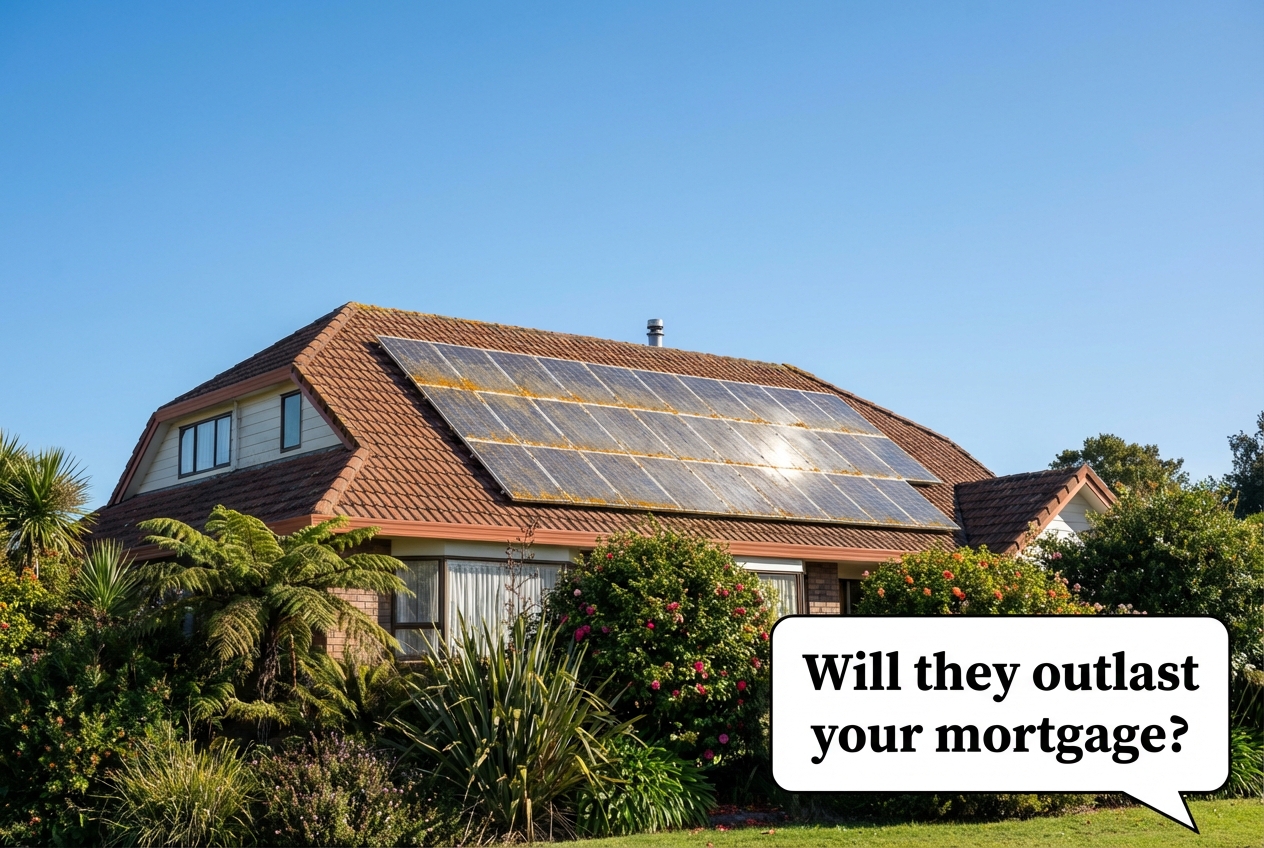
Solar panels are one of the few things you can buy for your house that genuinely last decades. Not “should last decades if everything goes perfectly” but actually, reliably, keep producing electricity for 25 to 30 years with barely any intervention.
The catch? Your panels will outlive the inverter by a wide margin. And there are a handful of NZ-specific conditions that can shorten the journey if you don’t plan for them. This guide covers all of it: real degradation data, warranty fine print, what actually breaks, and what you can do to keep your system running well past its warranty.
Want to know what solar would cost on your roof? Answer a few quick questions, get your personalised estimate, and compare quotes from vetted NZ installers.
The Short Answer
Modern solar panels last 25 to 30 years minimum, and many will keep producing useful electricity well beyond that. They don’t suddenly stop working one morning. Instead, they gradually produce a tiny bit less each year.
How tiny? The National Renewable Energy Laboratory (NREL) studied nearly 2,000 solar systems worldwide and found that modern monocrystalline panels degrade at roughly 0.4% per year. That means after 25 years, your panels are still producing 85 to 92% of their original rated output.
EECA (the Energy Efficiency and Conservation Authority) confirms a 25+ year lifespan for residential solar in New Zealand, with a typical payback period of around 7 years. So you’re looking at 18+ years of near-zero electricity costs after the system has paid for itself.
- 25 to 30 years: the warranted lifespan for most quality panels
- 0.3 to 0.5% per year: the typical degradation rate for modern mono panels
- 85 to 92%: expected output at year 25
- 7 years: average payback period in NZ (EECA)
How Panels Degrade Over Time
Degradation isn’t linear. Most panels experience a slightly larger drop in their first year, called light-induced degradation (LID). For traditional P-type cells, this first-year drop is typically 2 to 3%. Newer N-type and TOPCon cells have minimal LID, which is one reason they’re becoming the industry standard.
After that initial dip, the decline settles into a steady, barely noticeable slide. The table below shows what this looks like across three panel technologies over 30 years.
| Year | Standard (0.5%/yr) | N-type TOPCon (0.35%/yr) | Premium REC/SunPower (0.25%/yr) |
|---|---|---|---|
| Year 0 | 100% | 100% | 100% |
| Year 1 | 97% | 98% | 99% |
| Year 5 | 95% | 96.5% | 97.5% |
| Year 10 | 92.5% | 94.5% | 95% |
| Year 15 | 90% | 92.5% | 93% |
| Year 20 | 87.5% | 90.5% | 91% |
| Year 25 | 85% | 88.5% | 89% |
| Year 30 | 82.5% | 87% | N/A |
The difference between standard and premium panels over 25 years? About 4 to 7 percentage points of output. On a 6.6 kW system, that’s the difference between generating roughly 5,600 kWh and 5,900 kWh in year 25. Meaningful, but not dramatic.
Your panels at year 25 are like a car with 200,000 km on the clock. Still running fine, just not quite as peppy as day one.
Warranty Comparison: Every Major Brand
Solar panel warranties come in two flavours. The product warranty covers manufacturing defects, while the performance warranty guarantees a minimum output level over time. Both matter, but the performance warranty is what protects your long-term investment.
| Brand | Product | Performance | Output at 25 yr | Degradation |
|---|---|---|---|---|
| Jinko | 25 yr | 30 yr | ~90% | 0.4% |
| LONGi | 15 yr | 30 yr | ~87% | 0.4% |
| Canadian Solar | 25 yr | 25 yr | 83.1% | 0.55% |
| Trina | 25 yr | 30 yr | ~88% | 0.4% |
| REC | 25 yr | 25 yr | 92% | 0.25% |
| SunPower | 40 yr | 40 yr | ~92% | 0.25% |
| Q CELLS | 25 yr | 25 yr | 90.6% | 0.36% |
| JA Solar | 12 yr | 25 yr | ~84% | 0.55% |
A few standouts. Jinko, LONGi, and Trina now offer 30-year performance warranties, which is a big step up from the 25-year standard. SunPower leads the pack with a 40-year combined product and performance warranty, though you’ll pay a premium for it.
The real star of this table is REC, which guarantees 92% output at 25 years. That’s the best 25-year output guarantee of any manufacturer. Their Alpha series uses heterojunction (HJT) cells with an industry-leading 0.25% degradation rate.
One important caveat: warranties are only as good as the company behind them. A 30-year warranty from a manufacturer that goes bust in year 8 is worth nothing. Stick with established brands that have a strong track record and ideally a local or Australasian distribution presence.
The Inverter Problem (What Actually Fails)
Here’s the thing nobody puts in the marketing brochure: your panels will almost certainly outlive your inverter. String inverters, the most common type in NZ residential systems, last 10 to 15 years. That means you’ll likely need at least one inverter replacement during the life of your panels.
| Type | Lifespan | Warranty | NZ Replacement Cost |
|---|---|---|---|
| String (Fronius, Sungrow) | 10-15 yr | 5-12 yr | $1,500-$3,500 |
| Micro (Enphase IQ8) | 25+ yr | 25 yr | $200-$350 per unit |
| Hybrid (battery-ready) | 10-15 yr | 10 yr | $2,500-$5,000 |
Fronius is the most popular premium inverter brand in NZ. Their Primo and Symo lines are workhorses, but even they top out at around 12 to 15 years in practice. Sungrow offers a more budget-friendly option with similar lifespans.
Microinverters (primarily Enphase in the NZ market) are the exception. They sit behind each panel and are warrantied for 25 years. The trade-off? Higher upfront cost. But you avoid the mid-life replacement bill entirely, and you get panel-level monitoring and better performance when some panels are shaded.
Budget $2,000 to $3,000 for an inverter replacement at the 12-year mark. If you want to avoid that cost entirely, ask your installer about Enphase microinverters.
NZ-Specific Risks: UV, Salt, Humidity
New Zealand has a few environmental quirks that affect solar panel longevity differently than most overseas markets. The good news is that none of them are deal-breakers. The bad news is that some installers don’t account for them properly.
UV exposure
NZ’s peak UV index hits 12 to 13 in summer, which is roughly 40% higher than equivalent Northern Hemisphere latitudes (NIWA data). This is due to the thinner ozone layer over Australasia and NZ’s clear atmosphere.
High UV accelerates two things: encapsulant yellowing and backsheet degradation. The encapsulant is the clear layer that protects the silicon cells. Over decades of intense UV, it can yellow and reduce light transmission. Modern panels use POE (polyolefin elastomer) encapsulant instead of the older EVA type, which resists UV degradation significantly better.
Coastal salt spray
With 15,000 km of coastline, a huge proportion of NZ homes are within salt spray range. Salt corrosion attacks metal frames, mounting hardware, and electrical connections. If you’re within 1 km of the coast, check that your panels carry IEC 61701 salt mist corrosion certification. Use stainless steel mounting hardware, not galvanised steel.
Humidity and PID risk
Potential-induced degradation (PID) is a voltage-driven process that’s accelerated by high humidity. Northland and Bay of Plenty are the highest-risk regions in NZ. N-type cells are inherently more resistant to PID than older P-type cells. If you’re in a humid region, this is another reason to choose N-type panels.
Failure modes ranked by frequency
| Failure Mode | Frequency | Typical Age |
|---|---|---|
| Inverter failure | Most common | 10-15 yr |
| Potential-induced degradation (PID) | Common | 5-15 yr |
| Microcracks | Moderate | 5-20 yr |
| Backsheet degradation | Moderate | 15-25 yr |
| Bypass diode failure | Uncommon | 10-20 yr |
| Junction box failure | Uncommon | 10-20 yr |
| Salt corrosion (coastal) | Uncommon | 5-15 yr |
| Encapsulant yellowing | Rare | 20-30 yr |
Here’s the silver lining: NZ’s moderate temperatures actually help. Extreme heat is one of the biggest accelerators of panel degradation, and NZ rarely sees the 40 to 45 degree days that bake systems in Australia. Our cooler summers mean panels operate closer to their rated efficiency more often.
Maintenance That Actually Matters
Solar panels are often described as “set and forget”. That’s mostly true, but “mostly” is doing some heavy lifting. A small amount of regular maintenance can make a real difference to output and lifespan.
| Task | Frequency | Cost |
|---|---|---|
| Professional cleaning | Every 6-12 months | $100-$200 |
| Electrical inspection | Every 2 years | $150-$300 |
| Inverter monitoring | Ongoing | Free (app) |
| Gutter and mount check | Annually | DIY |
Dirty panels lose 15 to 25% of their output. Bird droppings, lichen, pollen, and salt residue are the most common culprits in NZ. Coastal properties and those near native bush tend to need more frequent cleaning.
One critical rule: never use high-pressure water on your panels. It can crack cells, damage seals, and void your warranty. A soft brush with a garden hose is all you need, or hire a professional who knows what they’re doing.
The single best maintenance tool is your inverter monitoring app. Fronius, Enphase, and Sungrow all have free apps that show daily generation. If output drops suddenly, you’ll catch it straight away instead of discovering the problem months later on your power bill.
The best-maintained solar system in the world is the one where the owner checks the app once a week and gets the panels cleaned twice a year.
End of Life: Recycling in NZ
What happens when your panels finally reach the end of their useful life? Until recently, the answer in NZ was “landfill”. That’s changing.
Phoenix Recycling now operates NZ’s first nationwide solar panel recycling service, with six collection locations around the country. Their process recovers 98% of panel materials, including glass, aluminium, silicon, silver, and copper. Given that a standard panel contains about 75% glass by weight, most of the material is straightforward to recycle.
If your panels are still producing at 70 to 80% of their original output, they don’t need to be recycled at all. They can be repurposed for sheds, garages, or off-grid setups where peak efficiency isn’t critical. A 25-year-old panel producing 85% is still a perfectly good panel for a workshop or holiday bach.
- No building consent needed for replacement panels since October 2025 (same exemption as new installs)
- The Ministry for the Environment is currently consulting on e-waste product stewardship that would include solar panels, potentially creating a funded collection and recycling programme
- Recycling costs are currently modest ($5 to $15 per panel) and are expected to drop as volumes increase
Common Questions
Do solar panels stop working after 25 years?
No. They just produce less. A well-maintained system at 25 years still produces 85 to 92% of its original output. Panels don’t have a hard expiry date. They gradually decline at 0.3 to 0.5% per year, and many systems continue generating useful electricity well into their 30s and beyond.
How often should I clean my solar panels in NZ?
Every 6 to 12 months depending on your location. Coastal properties and homes near trees or native bush should clean every 6 months. Inland properties with minimal tree cover can get away with an annual clean. Always use a soft brush and garden hose, never a high-pressure washer.
Will I need to replace my solar panels?
Unlikely during the first 25 to 30 years. The inverter is the component you’ll replace first, typically at year 10 to 15. Budget $1,500 to $3,500 for a string inverter replacement. The panels themselves should keep going for decades with only minor cleaning and inspections.
Does NZ's high UV damage solar panels?
NZ has roughly 40% higher UV than equivalent Northern Hemisphere latitudes. Modern panels handle this well, but it does accelerate encapsulant aging over very long timeframes. Choose panels with POE encapsulant and dual-glass construction for the best UV resistance. Avoid older EVA-encapsulated panels if possible.
Are solar panels covered by home insurance in NZ?
Yes. Roof-mounted solar panels are typically covered under your standard home insurance policy as part of the building. Ground- mounted panels usually fall under contents insurance instead. Either way, notify your insurer when you install solar and update your sum insured to reflect the added value.
Next steps for your solar journey
Written by Sarah Chen
Sarah has spent three years covering renewable energy in New Zealand, from residential rooftop systems to community solar projects. She holds a degree in Environmental Science from the University of Auckland.
Reviewed by
Matt Wilson
Registered Electrician & Solar Installer
Related guides
View all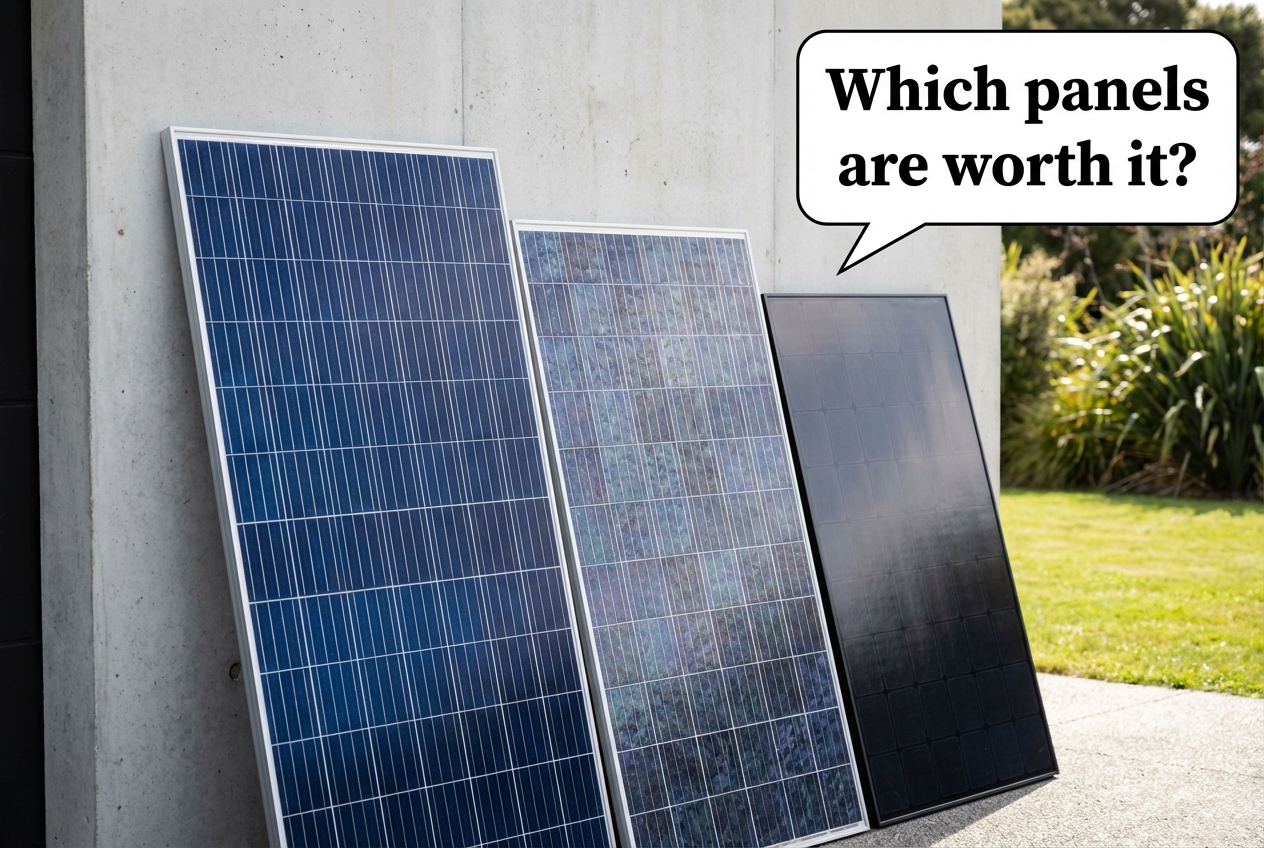
Best Solar Panels NZ: Brands, Tiers and What to Look For (2026)
Compare the best solar panels available in NZ. Tier 1 brands, specs, warranties, NZ pricing, and what installers actually use. TOPCon vs PERC vs HJT explained.
How Many Solar Panels Do I Need?
Work out how many solar panels your NZ home needs. Based on your power usage, roof space, and whether you're adding a battery or EV charger.
Is My House Suitable for Solar Panels?
Check if your NZ home is right for solar. Roof direction, pitch, shade, and structural factors explained for Kiwi houses.
Do Solar Panels Work in Winter and on Cloudy Days in NZ?
Solar panels still generate power on cloudy days and through NZ winters. Here's exactly how much output changes and why it still works.