
Best Solar Panels NZ: Brands, Tiers and What to Look For (2026)
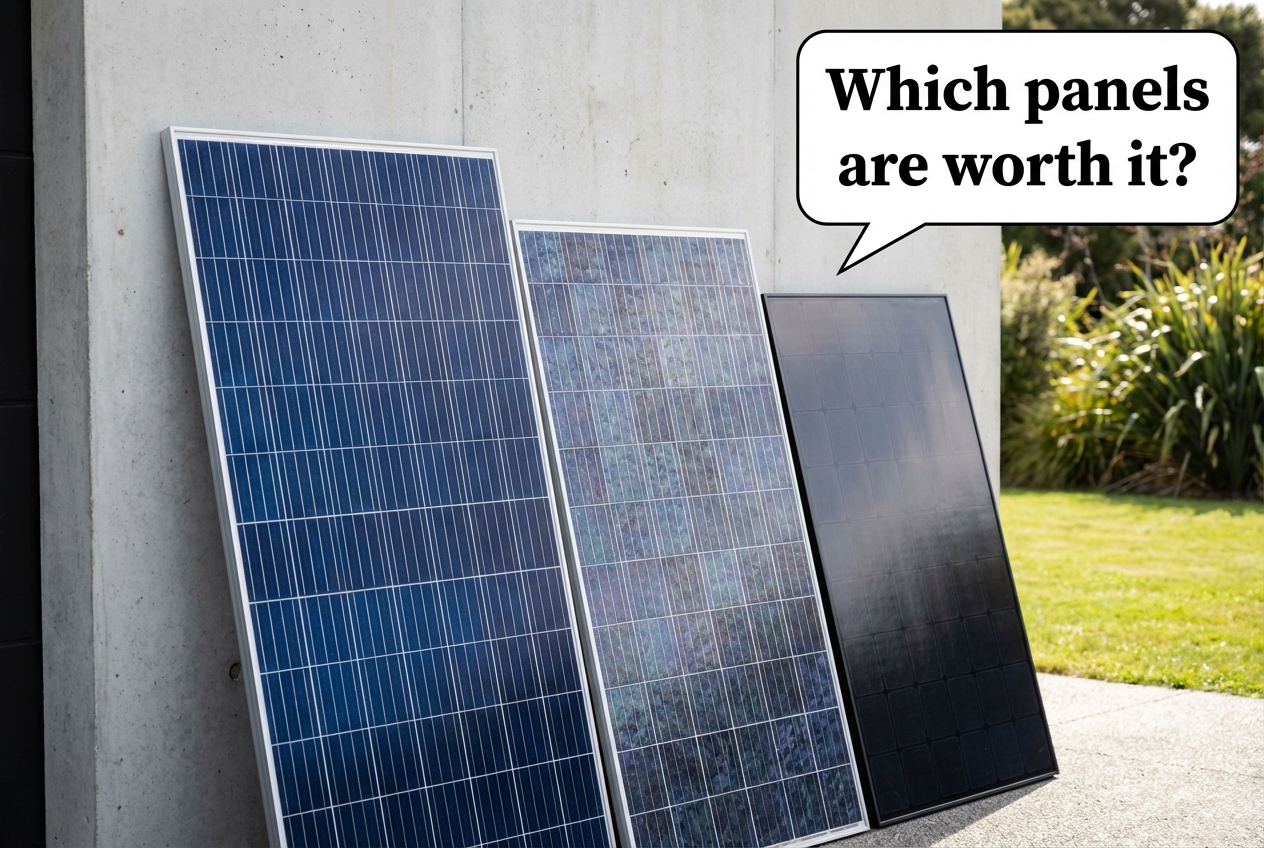
There are over 40 solar panel brands sold in New Zealand. Most homeowners will never see more than two or three of them, because installers standardise on the brands they trust. That’s not a bad thing. But it does mean the panel you end up with often depends more on which installer you choose than on any research you do beforehand.
This guide changes that. We’ve compared every major panel brand available in NZ, broken down the technology differences that actually matter, and matched each brand to the installers that use them. Whether you’re optimising for value, performance, or aesthetics, you’ll know exactly what to ask for.
Want to skip the research and get matched with vetted installers? Answer a few quick questions and we’ll connect you with trusted local companies who use the brands covered here.
Our Picks for NZ Homeowners
If you want the short version, here are five panels we’d recommend depending on your priorities. Each one is Tier 1, widely available in NZ, and backed by a warranty you can actually claim on.
Best overall value: Jinko Tiger Neo
The Jinko Tiger Neo is the workhorse of the NZ solar market. It uses N-Type TOPCon cell technology, hits 22% efficiency, and comes with a 30-year performance warranty at just 0.4% annual degradation. It’s the panel most installers default to when price and performance both matter, and for good reason. Widely available, competitively priced, and backed by the world’s largest solar manufacturer.
Best premium: REC Alpha Pure-R
REC is a Singapore-headquartered manufacturer with European R&D roots and a reputation for quality that borders on obsessive. The Alpha Pure-R uses heterojunction (HJT) cells, achieves 22.3% efficiency, and has the lowest degradation rate in the market at just 0.25% per year. That translates to roughly 92% output at 25 years. The 25-year product warranty is among the longest available. If you want the best panel money can buy and plan to stay in your home long-term, this is it.
Best for shade and aesthetics: Aiko INFINITE
Aiko’s INFINITE panel uses All Back Contact (ABC) cell technology to achieve a remarkable 24.8% efficiency, with 30% better shade performance than conventional panels. The all-black design looks sharp on any roof. The catch: it’s exclusive to Harrisons Solar in NZ, so you’re locked into one installer. If you have significant shading or care deeply about aesthetics, this panel is worth the conversation.
Best budget: JA Solar DeepBlue 4.0
JA Solar is one of the world’s top three panel manufacturers by volume. The DeepBlue 4.0 uses TOPCon cells, achieves 22% efficiency, and comes with a 30-year performance warranty and glass-glass construction. It’s a genuine budget option that doesn’t cut corners where it counts. Expect an 8 to 11 year payback depending on your location and usage. Very common across NZ installers.
Best for coastal NZ: Trina Vertex S+
If you live near the coast, salt mist corrosion is a real concern. The Trina Vertex S+ uses TOPCon technology in a dual-glass construction with enhanced salt and humidity resistance. It’s the panel of choice for Lightforce Solar, one of NZ’s largest installers. At 22.5 to 23.8% efficiency with a 30-year performance warranty, it’s a strong all-rounder even if you’re not on the coast.
What Tier 1 Actually Means
“Tier 1” is the most misunderstood term in solar. It does not mean “best quality.” It’s a financial classification from Bloomberg New Energy Finance (BNEF) that measures bankability: has this manufacturer supplied panels to at least six projects over 10 MW, financed by independent (non-Chinese) banks, in the past 24 months?
In practice, it’s a proxy for manufacturer stability. A Tier 1 company is large enough and financially sound enough that banks are willing to lend against their products. That matters because a 25 or 30 year warranty is only as good as the company standing behind it.
Tier 1 doesn’t mean best quality. It means banks trust the manufacturer enough to lend against their products. In practice, that’s a pretty good filter.
Why Tier 1 matters in NZ
All five major NZ bank green loans (Westpac at 0%, ANZ, ASB, and BNZ at 1%, and Kiwibank) effectively require Tier 1 panels. They do this indirectly: the loan condition is that you use a SEANZ-accredited installer, and SEANZ members use Tier 1 panels as standard. If you go with a non-Tier 1 panel, you may be paying 7%+ interest on a personal loan instead of 0 to 1% on a green loan. Over five years, that’s $4,500+ in extra interest on a typical system.
Current Tier 1 manufacturers
| Manufacturer | Country | Annual Capacity (GW) |
|---|---|---|
| Jinko Solar | China | 100+ |
| LONGi Green Energy | China | 100+ |
| Trina Solar | China | 80+ |
| Canadian Solar | Canada/China | 60+ |
| JA Solar | China | 75+ |
| REC Group | Singapore/Norway | 12+ |
| Q CELLS (Hanwha) | South Korea/Germany | 20+ |
| SunPower/Maxeon | USA/Singapore | 5+ |
| Aiko Solar | China | 30+ |
| Hyundai Energy | South Korea | 10+ |
Every Brand Compared
Here’s the full comparison of every major panel brand available in NZ. We’ve included the specs that actually matter for a residential install: efficiency, warranty length, long-term degradation, and how easy they are to find through NZ installers.
| Brand | Tech | Eff. | Wattage | Product Wty | Perf. Wty | 25yr Output | Degrad. | Price | NZ Avail. |
|---|---|---|---|---|---|---|---|---|---|
| Jinko Tiger Neo | TOPCon | 22-24.8% | 415-495W | 25yr | 30yr | ~90% | 0.4% | Mid | Widely available |
| LONGi Hi-MO X6 | HPBC | 22.5% | 440-630W | 25yr | 30yr | ~87% | 0.4% | Mid-Prem | Available |
| Canadian Solar | TOPCon | 22.5% | 445-470W | 25yr | 30yr | 87.4% | 0.4% | Mid | Common |
| Trina Vertex S+ | TOPCon | 22.5-23.8% | 440-475W | 25yr | 30yr | ~88% | 0.4% | Mid | Very common |
| REC Alpha Pure-R | HJT | 22.3% | 400-430W | 25yr | 25yr | 92% | 0.25% | Premium | Available |
| SunPower Maxeon 7 | IBC | 24.9% | 430-440W | 40yr | 40yr | ~92% | 0.25% | Ultra-prem | Limited |
| Q CELLS Q.TRON | N-Type | 22.5% | 425W | 25yr | 25yr | 90.6% | 0.33% | Mid-Prem | Available |
| JA Solar DeepBlue | TOPCon | 22.8% | 450W | 12yr | 30yr | 87.4% | 0.4% | Budget-Mid | Very common |
| Aiko INFINITE | ABC | 24.8% | 450-480W | 25yr | 30yr | N/A | 0.35% | Premium | Harrisons only |
| Hyundai | Various | 20-22% | 300-430W | 25yr | 30yr | N/A | N/A | Mid-Prem | Good |
A few things jump out. First, most Tier 1 panels now sit between 22% and 23% efficiency. The gap between “budget” and “premium” in raw efficiency terms is smaller than ever. Second, the real differentiators are degradation rate, product warranty length, and NZ availability. A panel with 0.25% annual degradation will produce noticeably more power in year 20 than one at 0.4%, and that compounds over the system’s lifetime.
Panel Technology: PERC vs TOPCon vs HJT
The technology inside the panel determines its efficiency, how it degrades over time, and how it performs in heat. Here’s what you need to know about the four main cell types on the NZ market.
| Spec | PERC | TOPCon | HJT | IBC |
|---|---|---|---|---|
| Max efficiency | ~21% | ~24% | ~23.5% | ~25% |
| Annual degradation | 0.5-0.55% | 0.4% | 0.25-0.3% | 0.25% |
| Temp coefficient | -0.35%/°C | -0.30%/°C | -0.26%/°C | -0.27%/°C |
| LID (light-induced degradation) | Moderate | Low | Very low | Very low |
| 2024 market share | ~30% | ~65% | ~3% | <1% |
| Cost premium vs PERC | Baseline | +5-15% | +15-30% | +40-80% |
TOPCon is the recommended technology for 2026
TOPCon (Tunnel Oxide Passivated Contact) has taken over the market for good reason. It offers meaningfully better efficiency, degradation, and temperature performance than PERC, at only a modest price premium. With 65% market share and climbing, it’s the new standard. Every major NZ installer now offers TOPCon as their default.
Don't buy PERC in 2026
PERC (Passivated Emitter and Rear Cell) was the dominant technology for a decade, but it’s now being phased out. Manufacturing lines are converting to TOPCon, and new PERC panels are increasingly hard to find. If an installer offers you PERC panels, ask why, and ask for the price difference. In most cases, TOPCon is a better investment even at a slightly higher price.
Half-cut cells are now standard
Modern panels use half-cut cells (each silicon wafer cut in two) rather than full-size cells. This reduces resistive losses, improves shade tolerance, and increases reliability. If you see a panel advertised with full-size cells, it’s likely old stock. Avoid it.
Bifacial panels: limited benefit on rooftops
Bifacial panels can absorb light from both sides, generating 2 to 5% more energy on ground-mounted systems with reflective surfaces. On rooftops, the rear side gets almost no reflected light, so the bifacial benefit is marginal. However, bifacial panels are typically dual-glass construction, which is genuinely valuable in NZ for UV resistance and structural durability. Buy bifacial for the glass, not the extra generation.
N-type vs P-type: N-type wins
TOPCon, HJT, and IBC are all “N-type” silicon. PERC is “P-type.” N-type wins on efficiency, degradation, and temperature performance. The 5 to 15% price premium pays for itself within the first few years through higher energy production. Every panel on our recommended list is N-type.
NZ-Specific Considerations
New Zealand has some unique environmental and regulatory factors that should influence your panel choice. Here’s what matters most.
UV exposure: 40% higher than the Northern Hemisphere
NZ sits under the thinnest part of the ozone layer, which means UV radiation is significantly higher than equivalent latitudes in Europe or North America. Over 25+ years, this accelerates degradation in lower-quality panels. Dual-glass construction (where the rear of the panel uses glass instead of a polymer backsheet) is recommended for NZ conditions. Most premium and mid-range panels now offer this as standard.
Coastal salt mist
If you live within a few kilometres of the coast, salt mist corrosion can damage panel frames and connections over time. Look for IEC 61701 salt mist certification, Level 6 minimum for coastal NZ properties. Stainless steel mounting hardware is also worth specifying. The Trina Vertex S+ and REC Alpha are both strong choices for coastal installs.
Wind loads
NZ gets serious wind. Panel mounting systems must comply with AS/NZS 5033, and we recommend panels rated for at least 4000 Pa wind load for most NZ homes. Your installer should assess your specific wind zone and specify mounting accordingly. This is one area where cheaper installations sometimes cut corners.
Green loan eligibility
Using Tier 1 panels through a SEANZ-accredited installer unlocks green loan rates from all major NZ banks. Here’s the current landscape:
| Bank | Interest Rate | Key Detail |
|---|---|---|
| Westpac | 0% | Up to 5 years, SEANZ installer required |
| ANZ | 1% | Up to 3 years, SEANZ installer required |
| ASB | 1% | Up to 3 years, SEANZ installer required |
| BNZ | 1% | Up to 3 years, SEANZ installer required |
| Kiwibank | Variable | $2,000 cashback, SEANZ installer required |
SEANZ requirements from September 2025
From September 2025, SEANZ introduced stricter installer requirements. Solar installations now require an electrician with a specific PV endorsement, and all work must include a Certificate of Compliance. This is good news for homeowners: it raises the bar for installation quality. Make sure your chosen installer meets these requirements, especially if you’re applying for a green loan.
What You'll Actually Pay
Panel pricing in NZ depends on the brand tier, your system size, and what’s included in the install. Here’s how costs break down at each level.
Panel-only pricing (per watt)
| Tier | Price per Watt | Example Brands |
|---|---|---|
| Budget | $0.45-0.65/W | JA Solar, generic Tier 1 |
| Mid-range | $0.65-0.90/W | Jinko, Trina, Canadian Solar |
| Premium | $0.90-1.30/W | REC, Q CELLS, Aiko |
| Ultra-premium | $1.30-1.80/W | SunPower Maxeon |
Fully installed system pricing
| System Size | Budget | Mid-Range | Premium |
|---|---|---|---|
| 3 kW | $7,000-8,500 | $8,500-10,000 | $10,000-12,000 |
| 5 kW | $9,500-11,500 | $11,500-13,500 | $13,500-16,000 |
| 6.6 kW | $11,000-13,000 | $13,000-16,000 | $16,000-20,000 |
| 10 kW | $14,000-17,000 | $17,000-21,000 | $21,000-27,000 |
Is premium worth it? The maths
Let’s compare REC Alpha Pure-R (premium, 0.25% degradation) against Jinko Tiger Neo (mid-range, 0.4% degradation) over 25 years on a 6.6 kW system.
The REC panel produces roughly 3.35% more lifetime energy thanks to lower degradation. On a 6.6 kW system generating about 9,000 kWh per year, that’s an extra 7,500 kWh over 25 years. At current blended electricity values (mix of self-consumption and export), that extra energy is worth $800 to $1,500.
The premium panels cost $2,000 to $4,000 more upfront. So in pure financial terms, the premium doesn’t quite pay for itself. But if you value the longer product warranty, lower environmental impact from slower degradation, or simply want the best available, it’s a reasonable choice. Not a clear financial win, but not unreasonable either.
Mid-range TOPCon panels are the sweet spot for most NZ homeowners. The premium over budget panels pays for itself easily, but the jump from mid-range to premium is more about preference than payback.
What NZ Installers Use
NZ solar installers typically standardise on one or two panel brands. This lets them build expertise, maintain stock, and negotiate better pricing. Here’s what the major installers are currently using.
Harrisons Solar
Panels: Aiko INFINITE (exclusive NZ partnership). Inverters: Fronius. Batteries: Tesla Powerwall. Harrisons is one of NZ’s largest installers with nationwide coverage. The Aiko exclusivity means you can only get these panels through Harrisons.
Lightforce Solar
Panels: Trina Vertex S+. Inverters and batteries: Sigenergy (integrated inverter/battery system). Lightforce operates across most of NZ and has standardised on the Trina/Sigenergy combination for streamlined installations.
CPS Solar
Panels: Jinko, Winaico, Trina, DAS Solar. CPS takes a multi-brand approach, giving customers more choice across price tiers. This flexibility can be an advantage if you have specific panel preferences.
Sky Solar and Queenstown Solar
Panels: Hyundai. The South Korean brand has a strong following in the upper South Island, with Sky Solar and Queenstown Solar both standardising on Hyundai panels.
AC Solar Warehouse
Panels: Jinko, Hyundai. AC Solar operates as a wholesale distributor, supplying panels and equipment to smaller installers across NZ. If your local installer uses Jinko or Hyundai panels, there’s a good chance they came through AC Solar.
The panel brand often follows the installer, not the other way around. Choose your installer for their quality of work, warranties, and reputation. The panel brand will follow.
Seven Mistakes to Avoid
After reviewing hundreds of solar quotes submitted to SolarScout, these are the most common mistakes we see NZ homeowners make when choosing panels.
[1] Chasing highest wattage instead of best value
A 500W panel sounds impressive, but wattage alone tells you very little. A larger panel produces more watts because it’s physically bigger, not necessarily because it’s better. Efficiency (watts per square metre) is what matters. Two 400W panels at 22% efficiency will outperform one 500W panel at 19% efficiency in the same roof area.
[2] Ignoring warranty terms
There are two warranties that matter: product warranty (covers manufacturing defects) and performance warranty (guarantees minimum output over time). Some budget panels offer just 12 years of product warranty despite a 30-year performance warranty. If the panel physically fails in year 15, you’re on your own. Look for at least 25 years on both.
[3] Not checking Tier 1 for loan eligibility
This is the most expensive mistake on this list. Using a non-Tier 1 panel (or a non-SEANZ installer) can lock you out of green loan rates. The difference between a 0 to 1% green loan and a 7%+ personal loan is $4,500 or more in interest over five years on a typical system. Always check that your installer is SEANZ-accredited and uses Tier 1 panels before signing.
[4] Oversizing instead of right-sizing
Bigger is not always better. NZ buy-back rates are low: you export at 7 to 16c/kWh but purchase at 30 to 45c/kWh. Every kWh you export instead of using is worth less than half of what you’d save by using it directly. Right-size your system for your actual daytime usage, or invest the difference in a battery to increase self-consumption.
[5] Relying on solar calculators alone
Online calculators (including ours) are useful for ballpark estimates, but they can’t account for your specific roof condition, shading patterns, electrical panel capacity, or local network constraints. Get at least three professional quotes with site assessments before committing. A 15-minute roof inspection reveals things no satellite image can.
[6] Dismissing non-north-facing roofs
North-facing is ideal in NZ, but east/west splits can actually save you more money. Why? An east/west split generates power across a longer part of the day, matching more of your morning and evening usage. That means higher self-consumption and less wasted export. For households with morning and evening usage peaks, an east/west split can outperform north-only in dollar terms.
[7] DIY installation
We see this question regularly: “Can I install panels myself and save on labour?” The short answer is no. In NZ, all electrical work must be done by a registered electrician. From September 2025, solar installations specifically require an electrician with a PV endorsement. DIY installation voids your product warranty, voids your home insurance coverage, disqualifies you from green loan rates, and is illegal for the electrical connection.
Common Questions
What is the best solar panel brand in NZ?
For most homeowners, Jinko Tiger Neo offers the best balance of efficiency, warranty, and price. For premium builds, REC Alpha Pure-R has the lowest degradation rate in the market. For shade-heavy properties, Aiko INFINITE (via Harrisons Solar) excels with 30% better shade performance than conventional panels.
Are Tier 1 solar panels worth it?
Yes, and in NZ it’s practically required. All major bank green loans (0 to 1% interest) need a SEANZ-accredited installer, who will use Tier 1 panels as standard. The alternative is a personal loan at 7%+ interest. On a $15,000 system over five years, that’s the difference between $375 and $4,875 in interest.
Should I buy TOPCon or PERC panels in 2026?
TOPCon. PERC is being phased out of production globally. TOPCon offers better efficiency (22% vs 21%), lower degradation (0.4% vs 0.5%), and better temperature performance. The 5 to 15% price premium pays for itself within the first few years through higher energy production. Every panel on our recommended list is TOPCon or better.
How much do premium solar panels cost in NZ?
Fully installed, a 6.6 kW system with mid-range panels (Jinko, Trina) costs $13,000 to $16,000. Premium panels (REC, Q CELLS) add $2,000 to $4,000 to that total. The extra lifetime energy production from premium panels is worth $800 to $1,500, so it’s a personal preference rather than a clear financial win.
Will solar panel prices go up in 2026?
Yes. After historic lows in 2024, panel prices rose 9% in Q4 2025 and are forecast to increase another 10 to 30% in 2026 as China tightens production capacity. Polysilicon prices have already started climbing. The best time to buy was last year. The second best time is now.
Next steps for your solar journey
Written by Sarah Chen
Sarah has spent three years covering renewable energy in New Zealand, from residential rooftop systems to community solar projects. She holds a degree in Environmental Science from the University of Auckland.
Reviewed by
Matt Wilson
Registered Electrician & Solar Installer
Related guides
View all
How Many Solar Panels Do I Need?
Work out how many solar panels your NZ home needs. Based on your power usage, roof space, and whether you're adding a battery or EV charger.
Is My House Suitable for Solar Panels?
Check if your NZ home is right for solar. Roof direction, pitch, shade, and structural factors explained for Kiwi houses.
Do Solar Panels Work in Winter and on Cloudy Days in NZ?
Solar panels still generate power on cloudy days and through NZ winters. Here's exactly how much output changes and why it still works.
Solar Panel Costs NZ: What You'll Actually Pay in 2026
Real pricing data for NZ solar in 2026. System costs by size, what affects price, and how to tell if a quote is fair.