
Can You Go Off-Grid with Solar in NZ?
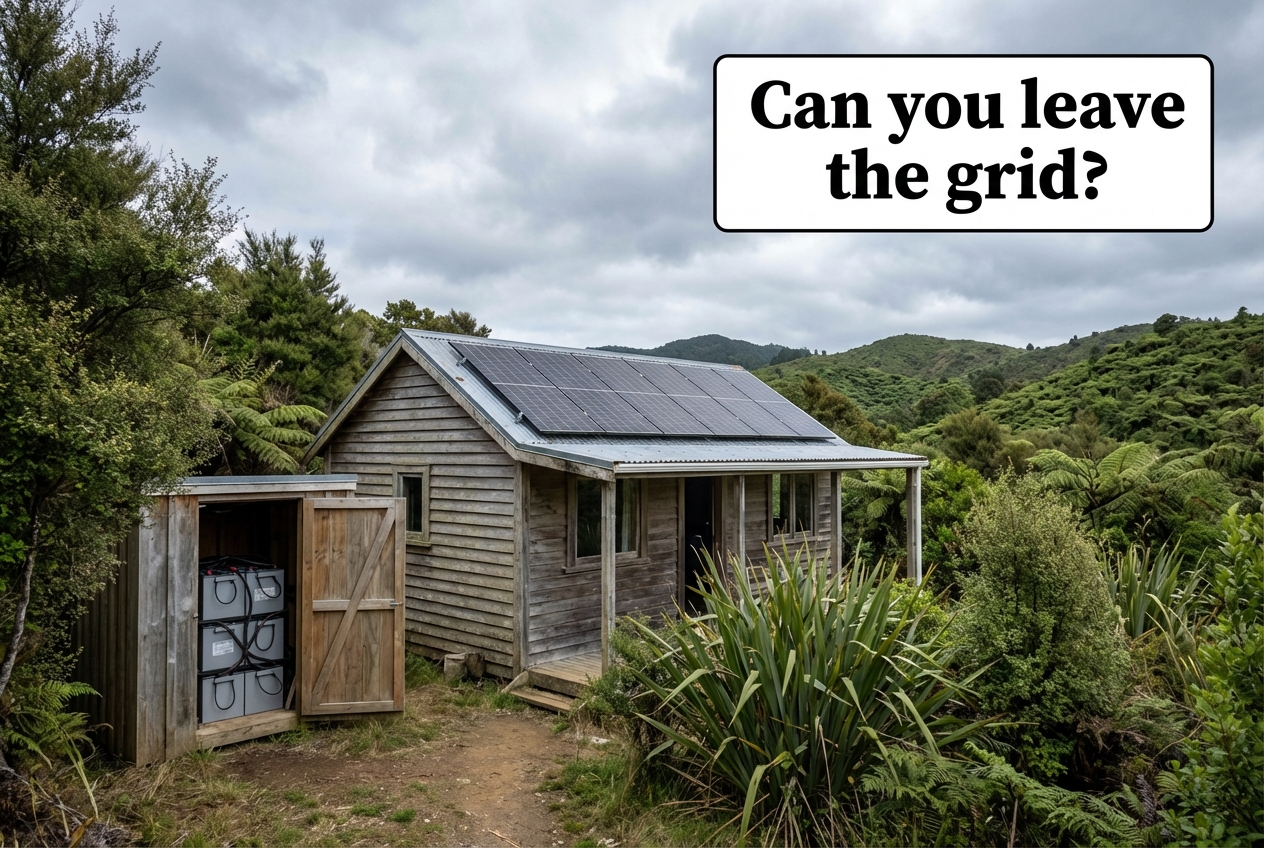
"I want to go off-grid." We hear this a lot. The idea of total energy independence, no power bills, no lines charges, no vulnerability to outages or price rises. It is genuinely appealing.
But here is the honest truth: for most New Zealand homeowners, going fully off-grid is the most expensive way to solve a problem that grid-tied solar already fixes for a fraction of the price.
This guide walks through all three options (grid-tied, hybrid, and off-grid), the real costs from NZ installers, the winter generation problem that catches people off guard, and exactly who off-grid actually makes sense for. Spoiler: it is probably less than 5% of Kiwi homeowners.
Your Three Options Explained
[1] Grid-Tied (90%+ of NZ installs)
Solar panels, a grid-connect inverter, and your existing grid connection. No batteries. Excess power goes to the grid for a buy-back credit (typically 7-12c/kWh). At night or on cloudy days, you draw from the grid as normal.
- Lowest upfront cost: $13,000 - $18,000 for a typical home
- Fastest payback: 5-7 years
- Simplest system, least maintenance
- The grid acts as your "infinite battery"
- No power during grid outages (inverter shuts down for safety)
- Still paying lines charges ($1.50+/day fixed)
[2] Hybrid (Grid-Tied + Battery)
Everything from grid-tied, plus a battery bank and hybrid inverter. Solar charges the battery during the day. You use stored energy in the evening. During outages, the battery provides backup power. You can still export excess to the grid.
- Total cost: $20,000 - $35,000 for solar + battery
- Backup power during outages (6-12 hours for essential loads)
- 70-90% savings on usage charges possible
- Battery adds complexity and a 10-15 year replacement cycle
- Still paying lines charges
[3] Off-Grid (Fully Independent)
Completely disconnected from the grid. Oversized solar array, large battery bank, off-grid inverter, monitoring system, and almost certainly a backup generator. You are your own power company.
- Total cost: $38,000 - $100,000+ depending on system size
- No monthly power bills, no lines charges
- Complete energy independence
- Generator fuel and maintenance: $500 - $1,500/year
- Battery replacement every 10-15 years: $15,000 - $30,000
- Requires daily energy management and lifestyle adjustments
- Reduced property resale value (fewer buyers want the responsibility)
Here is the side-by-side comparison:
| Grid-Tied | Hybrid | Off-Grid | |
|---|---|---|---|
| Upfront cost | $13,000 - $22,000 | $20,000 - $35,000 | $38,000 - $100,000+ |
| Monthly power bill | Reduced 30-50% | Reduced 70-90% | $0 |
| Lines charges | $1.50+/day ($550+/yr) | $1.50+/day ($550+/yr) | $0 |
| Generator fuel | N/A | N/A | $500 - $1,500/yr |
| Battery replacement (10-15 yrs) | N/A | $12,000 - $15,000 | $15,000 - $30,000 |
| Payback period | 5-7 years | 7-10 years | 10-15+ years (or never) |
| Outage protection | None | 6-12 hours essential loads | Full independence |
What Off-Grid Actually Costs
These are real installed prices from ZEN Energy NZ (GST inclusive). They include panels, batteries, inverter, charge controller, monitoring, and installation. Generator is additional.
| Tier | Panels | Battery | Total Cost |
|---|---|---|---|
| Small | 14 panels (6.16 kW) | 20 kWh | ~$38,700 |
| Medium | 20 panels (8.8 kW) | 30 kWh | ~$58,300 |
| Large | 28 panels (12.32 kW) | 40 kWh | ~$69,500 |
| Mega | 36+ panels (16+ kW) | 50+ kWh | $80,000 - $100,000+ |
Add roughly $8,000 for a backup generator. Most NZ off-grid installers consider this non-negotiable, and they are right. We will explain why in the winter section below.
Component costs if you source separately
Power Station NZ offers component-only pricing: from $15,995 for a small house, $29,500 for medium, $36,950 for large, and $45,200+ for mega. Installation adds $4,000 - $9,000+ depending on complexity. These are useful benchmarks if you are getting multiple quotes.
A well-sized off-grid system costs roughly 3-4x what a grid-tied system costs. That is the core number to sit with before making a decision.
The Winter Problem
This is where most off-grid plans fall apart. New Zealand sits at mid-latitudes, which means solar output drops dramatically between June and August. Christchurch data tells the story:
| Season | Output per kW | Note |
|---|---|---|
| Summer (Dec-Feb) | 6.61 kWh/day per kW | Peak generation |
| Autumn (Mar-May) | 3.47 kWh/day per kW | 47% drop |
| Spring (Sep-Nov) | 5.55 kWh/day per kW | Recovering |
| Winter (Jun-Aug) | 2.06 kWh/day per kW | 69% drop from summer |
A 69% drop from summer to winter. That is not a rounding error; it is the fundamental challenge of off-grid solar in NZ.
What this means in practice
The average NZ home uses about 22 kWh/day. A 10 kW off-grid system in Christchurch generates roughly 20.6 kWh/day in winter on a clear day. That barely covers average usage, with zero margin for cloudy days.
On cloudy winter days? Maybe 8-12 kWh. After two or three consecutive overcast days, you are running the generator. This is especially true in Manawatu, the Central Plateau, the West Coast of the South Island, and anywhere south of Canterbury.
Peak sun hours in winter
- Auckland: 4.0 - 4.6 hours/day
- Wellington: about 99 sunshine hours in June (vs 250 in January)
- Nelson: about 143 sunshine hours in June (one of the sunniest)
- Invercargill: roughly 2 peak sun hours/day
In winter, your solar panels produce about a third of what they generate in summer. Off-grid without a generator is not a real option in NZ.
Battery Sizing: The Maths
Battery sizing is the make-or-break calculation for off-grid. Too small and you are running the generator constantly. Too large and you have spent tens of thousands on capacity you will never use.
The formula
Required battery capacity = (Daily winter consumption x Days of autonomy) / (Depth of discharge x Round-trip efficiency)
- Daily winter consumption: how much you use per day in winter (often higher than summer due to heating)
- Days of autonomy: how many cloudy days you want to ride through without a generator (typically 1-3)
- Depth of discharge (DoD): 80% for lithium LFP, 50% for lead-acid
- Round-trip efficiency: 95% for lithium, 80-85% for lead-acid
Worked example: modest off-grid home
A household that has reduced their consumption to 15 kWh/day (smaller hot water cylinder, no heat pump, energy-conscious habits). They want 2 days of autonomy with lithium batteries.
15 kWh x 2 days / (0.80 x 0.95) = 39.5 kWh battery bank
At current NZ installed pricing of $1,000 - $1,200/kWh, that is $39,500 - $47,400 for batteries alone. Before panels, inverter, or installation.
What about 3 days of autonomy?
For a standard NZ home using 22 kWh/day and wanting 3 days without a generator:
22 kWh x 3 days / (0.80 x 0.95) = 86.8 kWh battery bank
Cost: $86,800 - $104,200 just for batteries. This is why most off-grid systems target 1-2 days of autonomy and pair with a backup generator.
Holiday bach example
A bach using 5 kWh/day with 3 days of autonomy:
5 kWh x 3 days / (0.80 x 0.95) = 19.7 kWh. Much more reasonable at around $19,700 - $23,700 for batteries.
Are batteries getting cheaper?
Not as fast as you might hope. Solar panels dropped about 50% in cost in 2023 alone. Battery prices have remained relatively flat through 2023-2025, averaging $1,249/kWh in 2024 survey data (range $800 - $1,200/kWh depending on brand and size).
Manufacturing efficiency gains are being offset by rising material costs. Expect slow, incremental decreases rather than the dramatic drops we saw with panels.
The Hybrid Middle Ground
For most homeowners who want energy independence without the cost and complexity of off-grid, a hybrid system is the realistic answer.
What a typical hybrid system looks like
- Solar array: 6-10 kW (16-24 panels)
- Hybrid inverter: Fronius GEN24 Plus or Sungrow SH series
- Battery: 10-15 kWh (Tesla Powerwall 3, BYD, or Sungrow SBR)
- Total cost: $22,000 - $35,000
Real-world self-sufficiency numbers
- Summer: 80-90% self-sufficiency
- Shoulder seasons: 60-70%
- Winter: 40-50%
- Annual average: 60-75% grid independence
- Annual bill reduction: 70-90% on usage charges
That last 25-40% is where the grid earns its keep. Instead of spending $30,000-$60,000 extra to cover it with batteries and a generator, you pay a few hundred dollars a year in grid power. The maths strongly favour the hybrid approach.
Outage protection
Most hybrid inverters offer backup gateway functionality. During a grid outage, the system automatically switches to battery power. A Tesla Powerwall 3 (13.5 kWh) can run essential loads (lights, fridge, internet, phone charging) for 6-12 hours.
Vanadium flow batteries: the emerging option
Zion Technologies in NZ supplies vanadium redox flow batteries. These offer 100% depth of discharge with zero degradation, a lifespan of 25-30 years (20,000-30,000+ cycles), and they are non-flammable with a water-based electrolyte that is fully recyclable.
The trade-off: they need 3-4x the physical footprint of lithium for the same capacity, and the upfront cost per kWh is higher. Better suited for farms, rural properties, and commercial sites with space. Not practical for a typical suburban garage.
Want to know what a hybrid system would cost for your home? Answer a few quick questions and we will connect you with vetted NZ installers who can quote on both grid-tied and hybrid options.
EDB Export Limits by Region
Export limits cap how much electricity your solar system can push back to the local network at any one time. They exist to maintain voltage stability. Most NZ distributors historically set these at 5 kW for single-phase residential connections, but many are now moving to 10 kW.
| Distributor | Region | Single-Phase Limit |
|---|---|---|
| Aurora Energy | Otago / Central | 10 kW |
| Powerco | Waikato / Taranaki / Manawatu | 10 kW |
| Northpower | Northland | 10 kW |
| Unison | Hawke's Bay / Taupo / Rotorua | 10 kW |
| PowerNet | Queenstown / Southland | 10 kW |
| Vector | Auckland | 5 kW |
| Orion | Canterbury / Christchurch | 5 kW |
| Wellington Electricity | Wellington | 5 kW |
The Electricity Authority has proposed mandating 10 kW as the default residential export limit. A decision is expected April 2026.
Why this matters for off-grid decisions
A 5 kW export limit does not mean you can only install 5 kW of solar. You can install a larger system and self-consume the excess, or use export-limiting on the inverter. But if you were considering off-grid partly because of export restrictions, the shift to 10 kW limits weakens that argument.
Higher export limits mean your grid-tied system can sell more surplus power. Combined with a battery to shift usage to peak hours, you capture more value from each panel without disconnecting from the grid.
Who Should Actually Go Off-Grid
Off-grid makes financial sense in a narrow set of circumstances. Here is the real decision framework.
The Morrinsville case study
A rural Waikato property where the grid connection was quoted at over $75,000. ZEN Energy installed a 5.92 kW off-grid system (16 LONGi panels, 8 Pylontech lithium batteries, Fronius + Selectronic inverter, backup generator). After four years, the owner reports they "don't need the generator very often at all."
The system cost significantly less than the grid connection, and now there are no ongoing power bills. This is the textbook case where off-grid wins.
Grid connection costs for rural NZ
- Per kilometre of new power line: roughly $25,000/km
- Transformer (if needed): $4,000 - $5,000
- Lifestyle block example: 800m of 3-phase mains + transformer = $100,000+
- Urban connection: $5,000 - $15,000
The break-even rule: if you have been quoted more than $40,000 - $50,000 for a grid connection, off-grid solar is almost certainly cheaper. And after connection, you would still pay monthly power bills and lines charges. Off-grid eliminates both.
Off-grid makes sense if you are:
- Remote: grid connection quoted at $40,000+ (common for rural and lifestyle blocks)
- Building new: on a remote site where no grid infrastructure exists
- A bach or holiday home: low usage, seasonal property, no existing connection
- On a farm or large rural property: high usage but also high fixed charges, plus space for larger systems
- Ideologically committed: energy independence is worth the premium to you, and you accept the lifestyle trade-offs
Common regrets from off-grid homeowners
- Undersizing is the number one mistake. One homeowner could not regularly run their dishwasher due to insufficient generation.
- Energy management becomes a daily chore: "you have to consciously avoid running big devices together, or invest in a higher-capacity system"
- Generator dependency in winter is higher than most people expect
- Property resale is harder with fewer buyers wanting off-grid responsibility
The Honest Answer
For 95% of New Zealand homeowners, the smartest move is grid-tied solar now, with a battery added later. Not off-grid.
Here is why. A grid-tied system at $13,000 - $18,000 pays for itself in 5-7 years and saves $2,000 - $3,000 per year after that. The grid handles nights, cloudy days, and winter shortfalls. You change nothing about how you live.
An off-grid system at $50,000 - $70,000 saves $2,500 - $3,500 per year (power bills plus lines charges). That is a 15-20+ year payback, before factoring in battery replacements at $15,000 - $30,000 every 10-15 years and generator fuel at $500 - $1,500 per year. And you need to actively manage your energy consumption every single day.
The grid is, essentially, a free infinite battery. It absorbs your excess generation and fills the gaps when your panels cannot keep up. Going off-grid means spending $30,000 - $50,000 extra to replace something that already works.
The fixed line charge wild card
There is one factor that could shift the equation over time. Fixed line charges are being deregulated. The current cap of $1.50/day increases by $0.30/year, and by April 2027 there will be no cap at all. Lines companies will be able to charge whatever they want for grid connection.
If daily fixed charges rise to $3-5/day ($1,100 - $1,800/year), the incentive to disconnect grows. But even then, a hybrid system with a battery is likely the smarter play. You keep the grid as backup for winter while minimising what you draw from it.
The recommended path
- Step 1: Start with grid-tied solar ($13,000 - $18,000). Payback in 5-7 years.
- Step 2: Add a battery when prices improve or when you want backup power. This moves you to hybrid.
- Step 3: If fixed line charges become unreasonable, consider full disconnection at that point. Your hybrid system is already 80% of the way there.
Only skip straight to off-grid if the grid connection itself costs more than the solar system. That is the Morrinsville rule.
Common Questions
Is it legal to go off-grid in NZ?
Yes. There is no legal requirement to be connected to the electricity grid. You are free to disconnect. Electrical work must still be done by a certified electrician, and an energy work certificate is required for all installations.
Do I need building consent for solar panels?
Most rooftop solar installations are exempt from building consent as of 2025. Arrays under 40 m2 on existing residential buildings in non-extreme wind zones are covered by the Building (Exempt Roof-mounted Solar Panel Arrays) Order 2025. The electrical work itself still requires a certified electrician.
What happens to my hot water if I go off-grid?
You lose access to ripple-controlled hot water tariffs (discounted rates in exchange for the lines company switching off your cylinder during peak demand). The alternative: solar diverters like SunStash (made in Ashburton, NZ) redirect excess solar generation directly to your hot water cylinder. This effectively turns your cylinder into a thermal battery. Heat pump hot water cylinders are another efficient option for off-grid homes.
Can I charge an EV off-grid?
Technically yes, but it requires significant additional capacity. An EV typically needs 8-12 kWh per day for average NZ driving. That is on top of your household usage. Most off-grid EV owners charge during peak solar hours only, which limits flexibility. A hybrid system with grid backup is far more practical for EV charging.
How long do off-grid batteries last?
Lithium iron phosphate (LFP) batteries, the current standard, last 10-15 years with 6,000-10,000 cycles. At that point, they still hold 70-80% capacity but performance degrades noticeably. Replacement cost: $15,000 - $30,000 depending on system size. Vanadium flow batteries from Zion Technologies last 25-30 years but cost more upfront and need significantly more space.
What size generator do I need for off-grid backup?
Most NZ off-grid installers recommend a diesel generator in the $8,000 range (installed). It does not need to be massive; it just needs to cover essential loads and battery charging during extended cloudy periods. The ZEN Energy Morrinsville installation uses one infrequently but considers it essential insurance.
Next steps for your solar journey
Written by Sarah Chen
Sarah has spent three years covering renewable energy in New Zealand, from residential rooftop systems to community solar projects. She holds a degree in Environmental Science from the University of Auckland.
Reviewed by
Matt Wilson
Registered Electrician & Solar Installer
Related guides
View all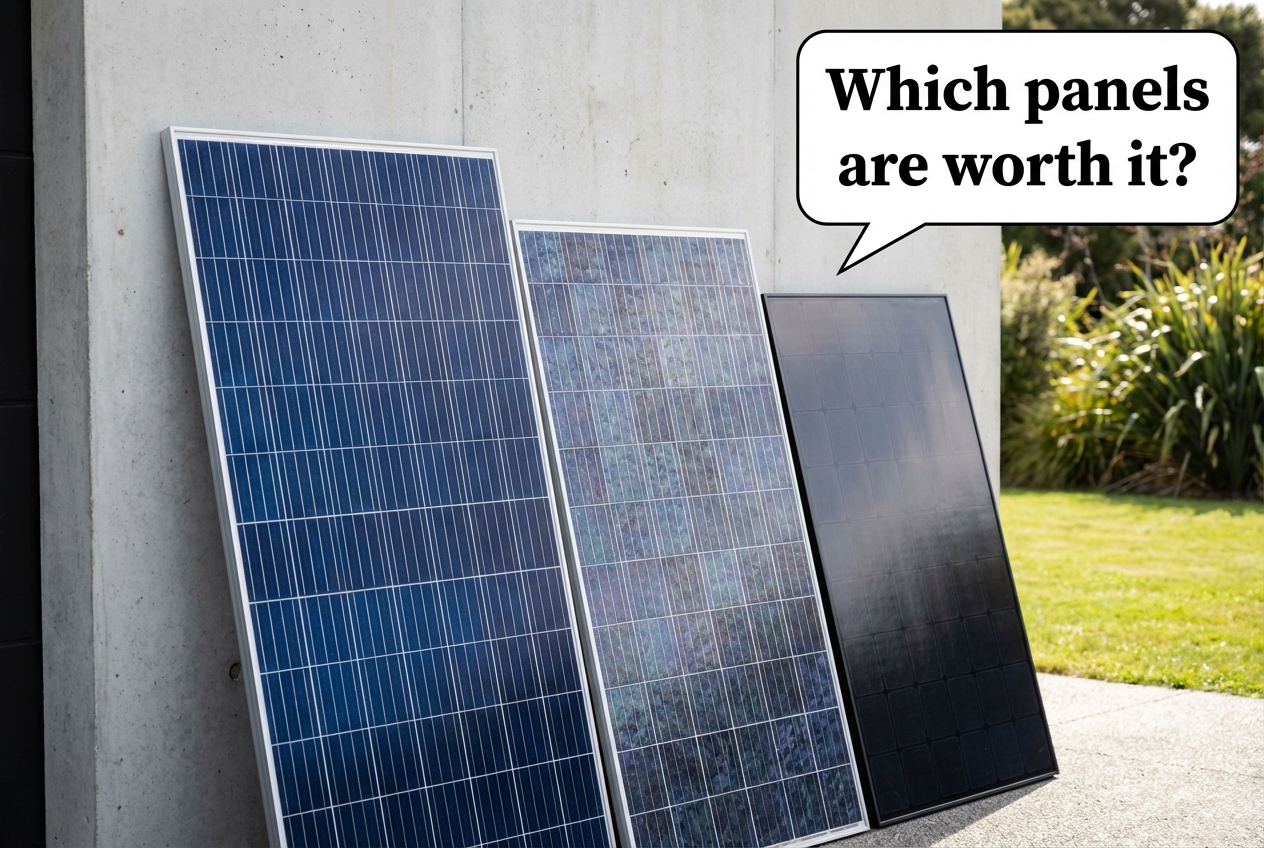
Best Solar Panels NZ: Brands, Tiers and What to Look For (2026)
Compare the best solar panels available in NZ. Tier 1 brands, specs, warranties, NZ pricing, and what installers actually use. TOPCon vs PERC vs HJT explained.
How Many Solar Panels Do I Need?
Work out how many solar panels your NZ home needs. Based on your power usage, roof space, and whether you're adding a battery or EV charger.
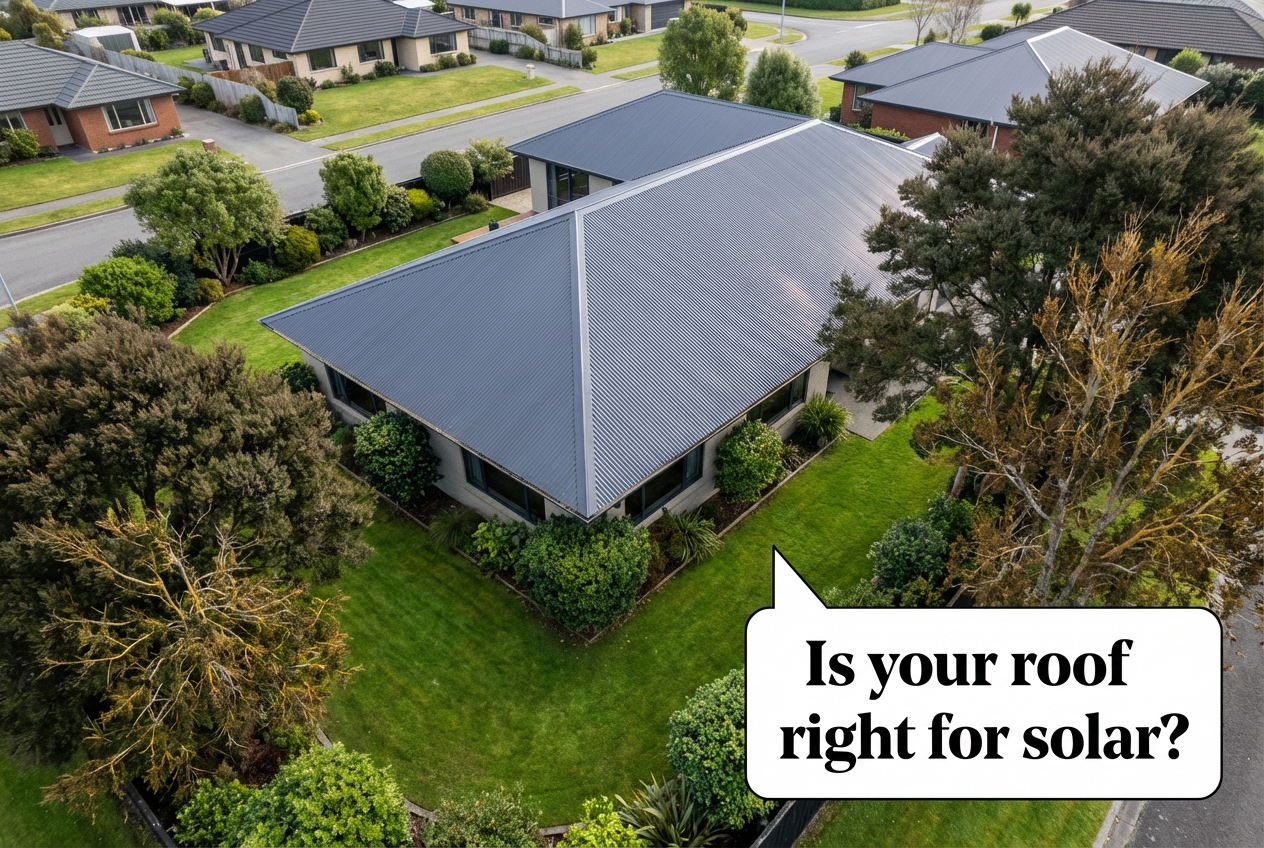
Is My House Suitable for Solar Panels?
Check if your NZ home is right for solar. Roof direction, pitch, shade, and structural factors explained for Kiwi houses.
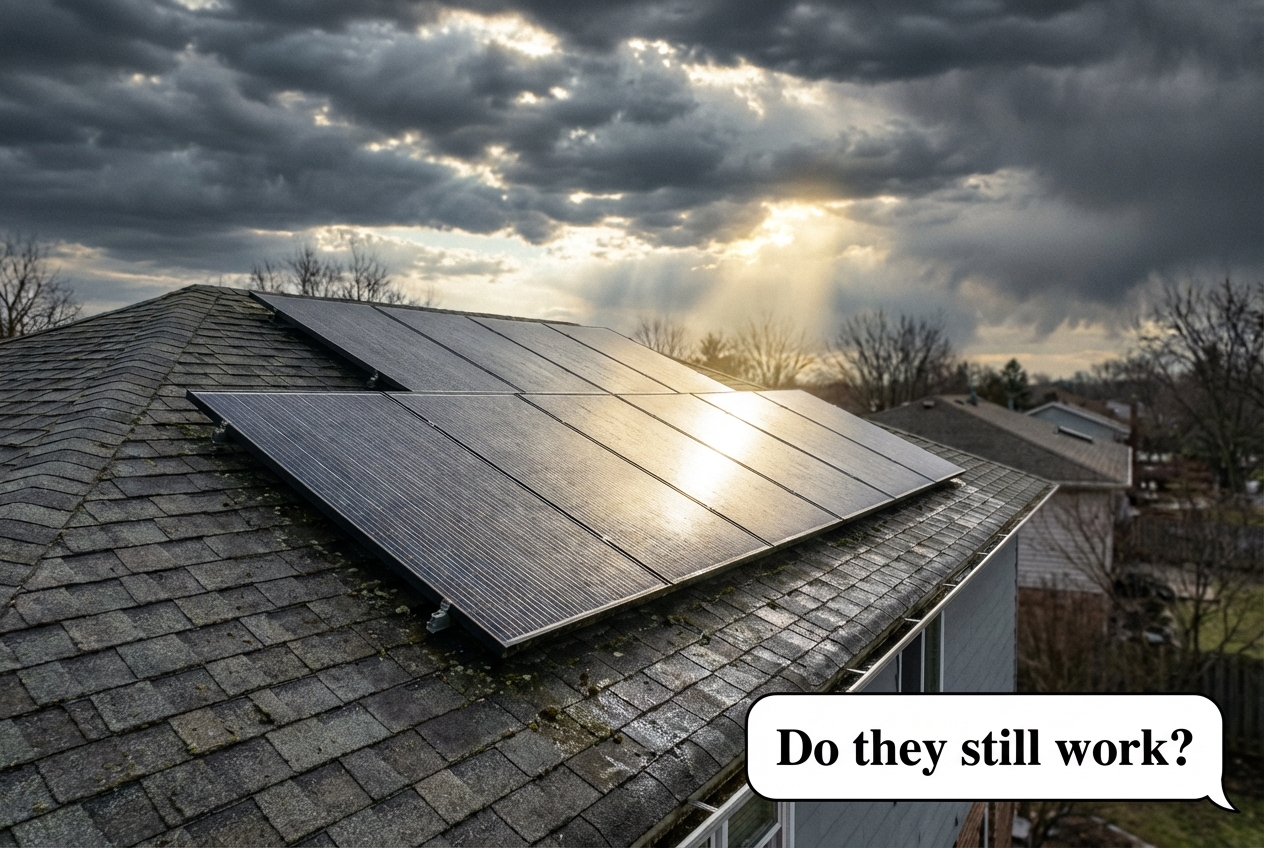
Do Solar Panels Work in Winter and on Cloudy Days in NZ?
Solar panels still generate power on cloudy days and through NZ winters. Here's exactly how much output changes and why it still works.