
How Many Solar Panels Do I Need?
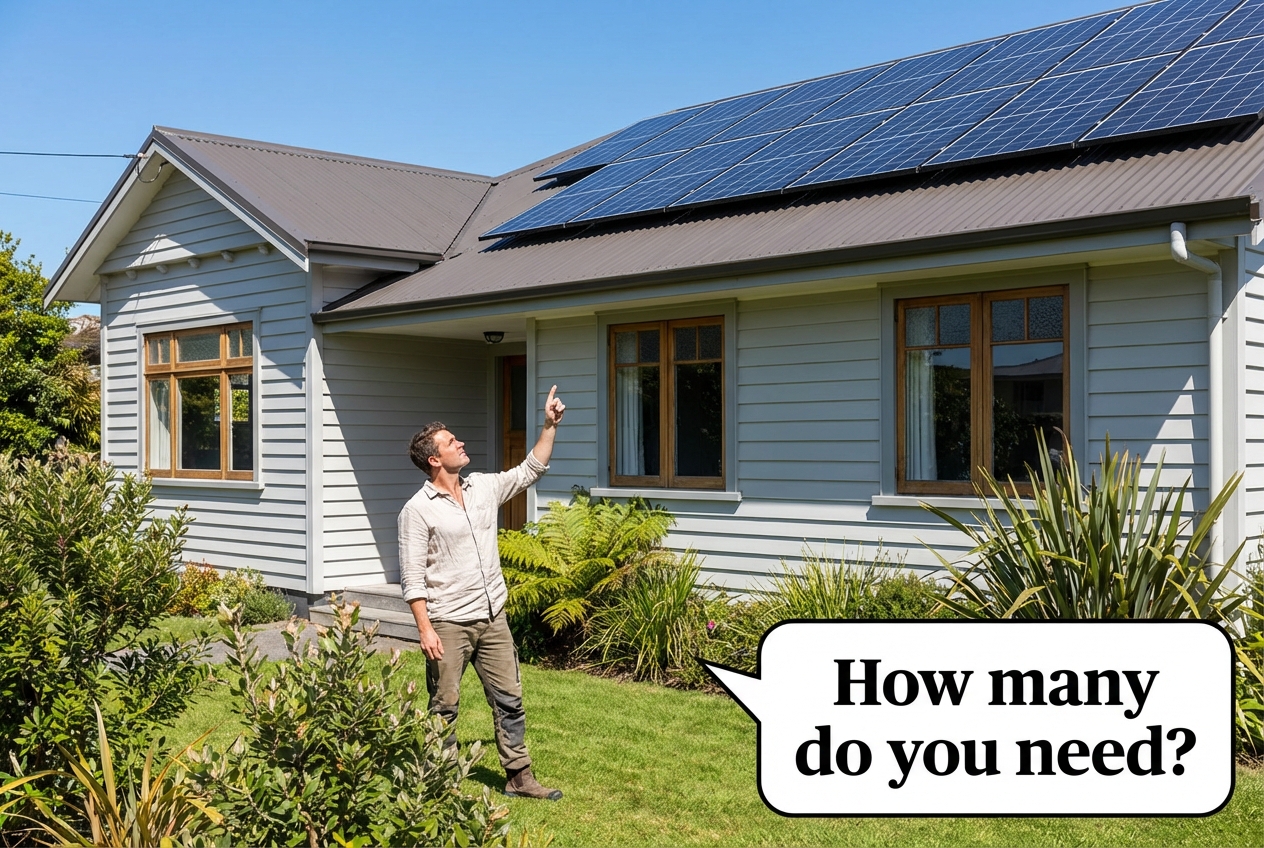
It depends on your power bill, your roof space, and what you are planning for the future. This guide walks through the maths so you can figure out the right system size before you talk to an installer.
PS We connect you with vetted solar installers across NZ. Answer a few quick questions, get your personalised estimate, and compare quotes from trusted local companies.
Key Takeaways
- Most NZ 3-bedroom homes need 12 to 15 panels (5 to 6.6 kW system).
- The quickest way to size your system: divide your annual kWh usage by 1,400. That gives you the system size in kW.
- Each modern panel is about 440W and takes up roughly 2 square metres of roof space.
- Where you live matters. A system in Nelson produces up to 40% more than the same system in Southland.
- When in doubt, go slightly bigger. Panels are cheap relative to installation costs, and your usage will likely grow.
The Quick Formula
If you want a rough answer without pulling out a calculator, here it is. Take your monthly power bill in dollars, multiply by 12, then divide by your electricity rate to get annual kWh. Divide that by 1,400. Done.
That magic number (1,400) is the average kWh a well-positioned 1 kW solar system generates per year across New Zealand. It accounts for seasonal variation, cloud cover, and the fact that not every roof faces due north at the perfect angle.
Annual kWh / 1,400 = system size in kW. Divide by 0.44 for panel count.
For example, if your household uses 8,000 kWh per year, you need roughly a 5.7 kW system. At 440 watts per panel, that works out to about 13 panels. Simple.
Of course, the real world is a bit messier than one formula. Your region, roof direction, shading, and future plans all play a role. We will walk through each of those below.
Step-by-Step: Calculate from Your Power Bill
Your power bill is the best starting point because it reflects how your household actually uses electricity, not some national average. Here is how to turn that bill into a panel count.
[1] Find your annual kWh usage
Check your latest power bill for the kWh figure. Most retailers show daily average usage. Multiply that by 365 to get your annual number. Alternatively, log into your retailer's portal (Meridian, Contact, Genesis, Mercury all have one) and look for a 12-month usage summary. That is the most accurate figure because it captures both summer and winter.
If you can only find a dollar amount, divide it by your electricity rate per kWh. Most NZ households pay between 28c and 38c per kWh depending on their retailer and region.
[2] Divide by 1,400
This gives you the system size in kilowatts (kW). The number 1,400 represents the average annual kWh output per kW of solar installed in New Zealand. It assumes a reasonably north-facing roof with minimal shading.
If you are in a sunnier region like Nelson or the Bay of Plenty, you could use 1,500 instead. If you are further south (Dunedin, Invercargill), use 1,200 to be safe. We have a full regional breakdown further down the page.
[3] Divide system kW by 0.44
Most panels installed in New Zealand right now are rated at 440 watts (0.44 kW). Dividing your system size by 0.44 tells you how many panels you need. You will sometimes see 400W or 410W panels in quotes from budget installers, or 450W+ from premium brands, but 440W is the current sweet spot for price and performance.
[4] Add a 20% buffer
This is optional but highly recommended. Adding 20% accounts for panel degradation over time (panels lose about 0.4% efficiency per year), days where production is lower than average, and any future increases in your power usage. If you are thinking about getting a heat pump, a home battery, or an EV in the next few years, this buffer is basically free insurance.
Worked example
Example: $300/month power bill
- Step 1: $300/month at 35c/kWh = 857 kWh/month = 10,286 kWh/year
- Step 2: 10,286 / 1,400 = 7.3 kW system
- Step 3: 7,300 / 440 = ~17 panels
- Step 4: With 20% buffer: ~20 panels (8.8 kW system)
That household would be looking at a system in the 8 to 10 kW range. At current pricing, that is roughly $13,000 to $18,000 installed. Not pocket change, but the system would offset the vast majority of their $3,600 annual power bill.
System Size by Household Type
Not everyone wants to dig through their power bill. If you just want a ballpark based on your household size, this table will get you close. These figures assume an average NZ household in a mid-range sunshine region like Auckland or Waikato.
| Household Type | Annual Usage | System Size | Panels (440W) |
|---|---|---|---|
| 1-2 people, efficient | 4,000 - 6,000 kWh | 3 - 4 kW | 7 - 9 |
| Average 3-bed | 7,000 - 9,000 kWh | 5 - 6.6 kW | 12 - 15 |
| Large family (4-5 people) | 10,000 - 14,000 kWh | 8 - 10 kW | 18 - 23 |
| With EV charging | +2,500 - 4,000 kWh | Add 2 - 3 kW | +5 - 7 |
| With pool or spa | +2,000 - 4,000 kWh | Add 2 - 3 kW | +5 - 7 |
A couple of things to note. The EV and pool/spa rows are additive. If you have an average 3-bed home and you are also charging an EV, you are looking at 17 to 22 panels total (7 to 9.6 kW). If you have both an EV and a pool, that could push you into the 22 to 30 panel range.
These numbers assume you want to offset most of your annual consumption. If you are happy covering 60 to 70% of your usage (which is perfectly reasonable, and still gives great returns), you can scale down by about a third.
How Your Region Affects System Size
New Zealand stretches a long way north to south, and that matters for solar. A panel in Nelson produces significantly more electricity than the same panel in Invercargill. If you are in a lower-output region, you need more panels (or a larger system) to generate the same amount of power.
Here is the approximate annual output per kW of solar installed, by region. Use this instead of the 1,400 average if you want a more accurate calculation.
| Region | kWh per kW/year | Note |
|---|---|---|
| Nelson / Marlborough | 1,550 - 1,650 | Highest in NZ |
| Bay of Plenty | 1,450 - 1,550 | Strong performer |
| Auckland | 1,350 - 1,450 | Solid year-round |
| Canterbury | 1,300 - 1,450 | Good despite cold winters |
| Wellington | 1,250 - 1,400 | Wind helps keep panels cool |
| Southland | 1,100 - 1,250 | Lowest, but still viable |
To use this table: take your annual kWh usage and divide by the regional figure instead of 1,400. If you are in Wellington using 9,000 kWh per year, that is 9,000 / 1,300 = 6.9 kW, or about 16 panels. An Auckland household with the same usage would only need 9,000 / 1,400 = 6.4 kW, or about 15 panels.
The difference between the sunniest and least sunny regions is roughly 40%. That is meaningful, but even in Southland, solar still makes financial sense for most households. The panels just need to be a bit bigger.
Even in Southland, solar payback periods are typically 8 to 10 years. Further north, expect 5 to 7 years.
How Much Roof Space Do You Need?
Each standard residential solar panel measures about 1.7 metres by 1.1 metres, which works out to roughly 1.9 square metres. With mounting frames and the required gaps between panels and roof edges, budget about 2 square metres per panel.
So for a 6.6 kW system (15 panels), you need around 30 square metres of usable, unshaded roof space. For a 10 kW system (23 panels), you are looking at about 46 square metres.
What counts as usable roof space?
- North-facing is ideal. In the southern hemisphere, north-facing roofs get the most direct sunlight throughout the day. A north-facing roof at around 30 degrees pitch is the gold standard.
- East and west still work well. You will lose about 10 to 15% compared to north, but it is absolutely still worth it. Many NZ homes split panels across east and west roof faces to maximise total production across the day.
- South-facing is poor. You will lose 30 to 40% output compared to north. Most installers will avoid south-facing panels unless there is genuinely no other option.
- Shading matters a lot. Even partial shade on one panel can reduce output from the entire string (unless you have microinverters or optimisers). Trees, neighbouring buildings, chimneys, and TV aerials are common culprits.
What if you do not have enough roof space?
If your roof is small, has multiple faces, or has a lot of shading, you have a few options. Higher-efficiency panels (450W+) give you more watts per square metre. Microinverters help if part of the roof is shaded. And in some cases, a ground-mounted system on a flat section of your property can be more effective than a roof mount, though it costs more to install.
The most common constraint we see is not total roof area, but usable north-facing area. If your north face is small, splitting panels across east and west faces is usually the best solution.
Should You Size for Today or the Future?
Short answer: size for the future if your roof and budget allow it.
Here is the thing about solar installation costs. The panels themselves are actually the cheapest part. The bulk of the cost is in the inverter, wiring, scaffolding, labour, and council paperwork. Adding a few extra panels during the initial install costs relatively little compared to coming back later and adding them as a separate job.
Think about what might change in the next 5 to 10 years:
- Are you likely to get an electric vehicle? That adds 2,500 to 4,000 kWh per year.
- Thinking about a heat pump for hot water? That could shift 1,500 to 2,500 kWh from gas to electric.
- Planning to add a battery later? A bigger system charges a battery faster and gives you more energy to store.
- Is your family growing? More people means more showers, more devices, more laundry.
- Working from home more? Home offices and daytime usage are perfect for solar.
Adding 4 extra panels during the initial install might cost $1,500 to $2,000. Adding them as a separate job later could cost $4,000 to $5,000 including a new inverter.
The main reason not to oversize is if your roof space is limited and you would need to put panels on a south-facing or heavily shaded section. In that case, quality of placement matters more than quantity.
What About EV Charging?
Electric vehicles are one of the biggest reasons Kiwi homeowners are upsizing their solar systems. The average NZ driver covers about 12,000 km per year. An efficient EV (like a Tesla Model 3 or BYD Atto 3) uses roughly 15 to 18 kWh per 100 km. That works out to 1,800 to 2,160 kWh per year just for driving.
But most people do not charge exclusively from solar. You charge overnight when rates are cheap, or during the day when the sun is out. If you can charge during daylight hours (working from home, or using a smart charger with solar diversion), you could realistically offset 50 to 70% of your EV charging with solar.
To fully cover EV charging from solar production, add 2 to 3 kW to your system size. That is 5 to 7 extra panels. If you are starting from scratch and know you will be getting an EV, factor this into your initial system design.
- Budget option: Charge from the grid overnight on a low night rate (some retailers offer 15 to 18c/kWh overnight). No extra panels needed.
- Mid option: Add 2 kW extra solar and use a smart charger that diverts excess solar to the car during the day.
- Full offset: Add 3 kW extra solar and pair with a battery. Charge the battery during the day, then charge the car from the battery in the evening.
What About Battery Storage?
Batteries do not change how many panels you need, but they change how useful those panels are. Without a battery, any solar power you generate but do not use immediately gets exported to the grid. Your retailer pays you a buy-back rate for that exported power, typically 7 to 17c/kWh. With a battery, you store that excess and use it in the evening when electricity costs 28 to 38c/kWh.
The maths is simple: you make more money (or save more, depending on how you look at it) using your own solar power than exporting it. A battery lets you do more of that.
If you are planning to add a battery, it makes sense to size your solar system slightly larger than your daytime needs. You want excess production during the day to fill the battery. A good rule of thumb: size your solar system for 120 to 130% of your total daily usage, not just your daytime usage.
- A typical NZ home battery is 10 to 13.5 kWh (Tesla Powerwall 3, BYD Battery-Box).
- To fill a 10 kWh battery from solar, you need about 3 to 4 kW of excess production during daylight hours.
- Battery prices in NZ range from $9,000 to $24,000 installed, depending on brand and capacity. See our battery storage guide for a full comparison.
One important note: you do not need a battery from day one. Many Kiwis install solar first, then add a battery a year or two later when prices drop or their needs change. Just make sure your inverter is "battery-ready" (most modern hybrid inverters are) so you are not paying for a full rewire later.
Export Limits: Does System Size Matter?
This is a question we get a lot, and the short answer is: export limits should not stop you from getting a larger system.
Every electricity distribution business (EDB) in New Zealand sets a limit on how much solar power you can export back to the grid at any given moment. The current default for most EDBs is 5 kW per phase (so 5 kW for a standard single-phase home, or 15 kW for three-phase). Many EDBs are in the process of increasing this to 10 kW per phase.
Here is the important bit: the export limit is about how much power you push back to the grid, not how much you generate. A 10 kW system in a household that uses 5 kW during the day will only export 5 kW at peak, which is within the limit. The more you use during the day (hot water, EV charging, battery charging), the less you export.
- Export limiting is automatic. Modern inverters can be configured to cap exports at whatever your EDB requires. Your installer handles this.
- You still use the full system. Even if exports are capped, any power used on-site is unrestricted. A larger system means more self-consumption and less bought from the grid.
- Batteries absorb the excess. If you have a battery, surplus production that would have been export-limited gets stored instead. This is one of the strongest cases for combining a larger system with a battery.
Bottom line: do not let export limits be the reason you downsize your system. The trend is towards higher limits, and self-consumption is where the real savings are anyway.
What to Do Next
You have got the formula, the tables, and the regional data. Now it is time to get a number that is specific to your home.
- Take our 2-minute solar survey. We will ask about your power bill, roof type, and what you are looking for. Based on your answers, we match you with up to three vetted local installers who will provide tailored quotes. No obligation, no spam.
- Compare quotes side by side. Look at system size, panel brand, inverter type, warranty terms, and the price per watt. Our solar panel cost guide explains what a fair price looks like.
- Check your roof. Our roof suitability guide walks through direction, pitch, shading, and structural requirements.
The best system is the one sized correctly for your home and your plans. Not the biggest. Not the cheapest. The one that matches your actual usage and saves you the most over its lifetime.
Frequently Asked Questions
How many solar panels do I need for a 3-bedroom house in NZ?
A typical 3-bedroom NZ home uses 7,000 to 9,000 kWh per year. That translates to a 5 to 6.6 kW system, which is 12 to 15 panels at 440W each. If you have a heat pump, multiple occupants, or higher-than-average usage, lean towards the upper end.
Can I just count panels from my neighbour's roof?
You can, but it is not very reliable. Your neighbour might have different panel wattages, different electricity usage, a different roof orientation, or they might have sized their system incorrectly. Use the calculation method in this guide for a figure tailored to your actual usage.
Do I need more panels if my roof faces east or west?
Not necessarily more panels, but you may need a slightly larger system to compensate. East and west-facing roofs produce about 10 to 15% less than north-facing ones. Many homes split their array across east and west faces, which actually gives a broader production curve throughout the day. Your installer will model this for your specific roof.
What if my power bill changes a lot between summer and winter?
That is completely normal. Winter bills are often 50 to 80% higher than summer due to heating. Use your full-year total (or a 12-month average) rather than a single month. If you are sizing based on one bill, a winter bill will oversize and a summer bill will undersize. Aim for the annual figure.
Is 440W the only panel size available?
No. Panels range from about 370W (older budget models) to 500W+ (premium panels). But 440W is the most common wattage being installed in New Zealand right now, and it offers the best balance of output, physical size, and price. Most quotes you receive will be for 400 to 450W panels.
How many panels do I need to go completely off-grid?
Going fully off-grid in NZ requires a much larger system than grid-connected solar. You would typically need 30 to 50+ panels, a large battery bank (30 to 60 kWh), and a backup generator for winter. The cost is $60,000 to $120,000+. For most urban and suburban homes, staying grid-connected and offsetting 80 to 100% of your usage is far more cost-effective.
Will adding panels to my existing system void the warranty?
It depends on how it is done. If you add panels of the same model and your original installer does the work, warranty continuity is usually straightforward. If you use a different installer or mix panel brands, some manufacturers may limit coverage. Always check with your original installer and panel manufacturer before expanding.
How long do solar panels last?
Most Tier 1 panels come with a 25-year product warranty and a 25 to 30-year performance warranty (guaranteeing at least 80 to 87% output at end of life). In practice, panels often last 30 to 35 years. Inverters typically need replacing after 10 to 15 years (string inverters) or last 25+ years (microinverters).
Does shading from trees affect how many panels I need?
Shading does not change how many panels you need in theory, but it changes where you can put them. Panels in shade produce very little power, and with a string inverter, one shaded panel can reduce the output of the entire string. The solution is either to remove the source of shade, use microinverters or optimisers, or avoid placing panels in shaded areas entirely. A good installer will assess shading as part of their site survey.
Written by Sarah Chen
Sarah has spent three years covering renewable energy in New Zealand, from residential rooftop systems to community solar projects. She holds a degree in Environmental Science from the University of Auckland.
Reviewed by
Matt Wilson
Registered Electrician & Solar Installer
Related guides
View all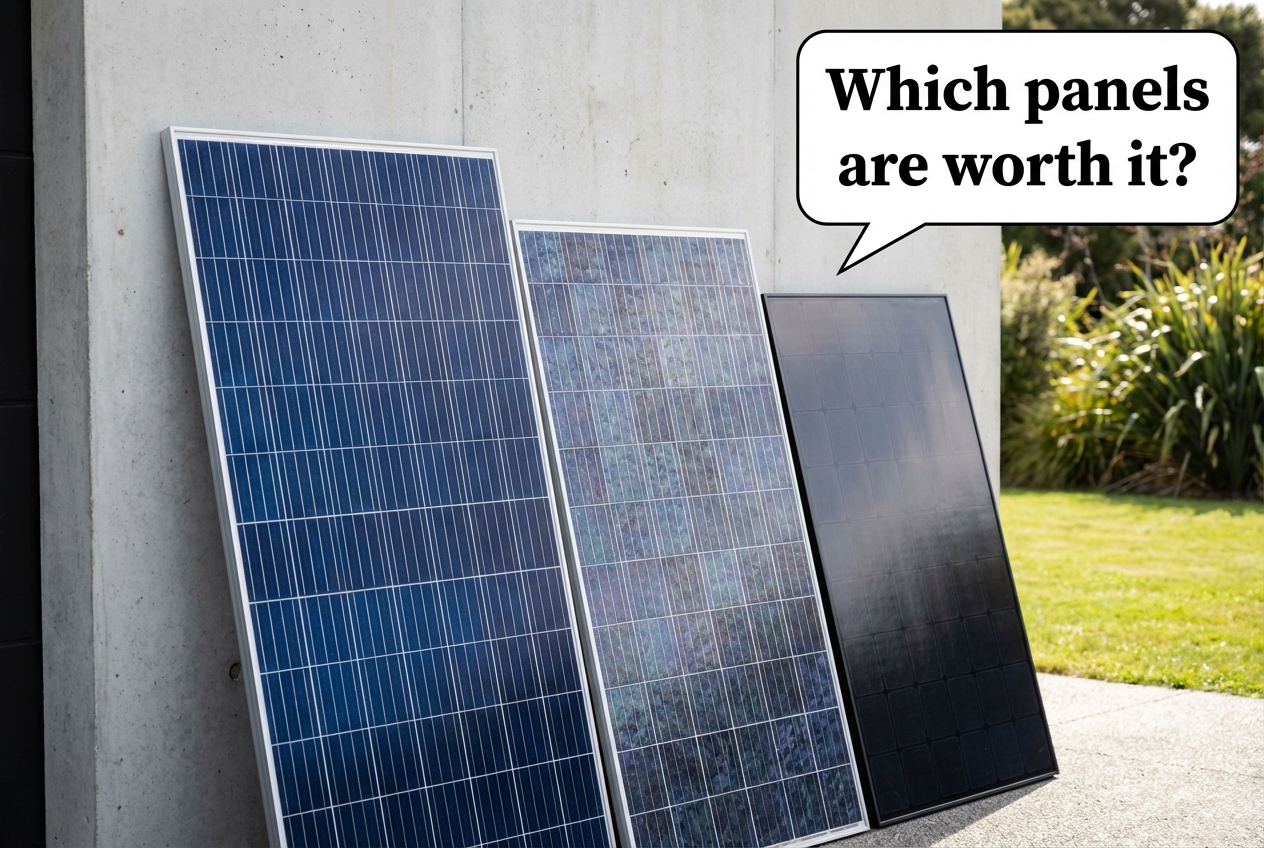
Best Solar Panels NZ: Brands, Tiers and What to Look For (2026)
Compare the best solar panels available in NZ. Tier 1 brands, specs, warranties, NZ pricing, and what installers actually use. TOPCon vs PERC vs HJT explained.
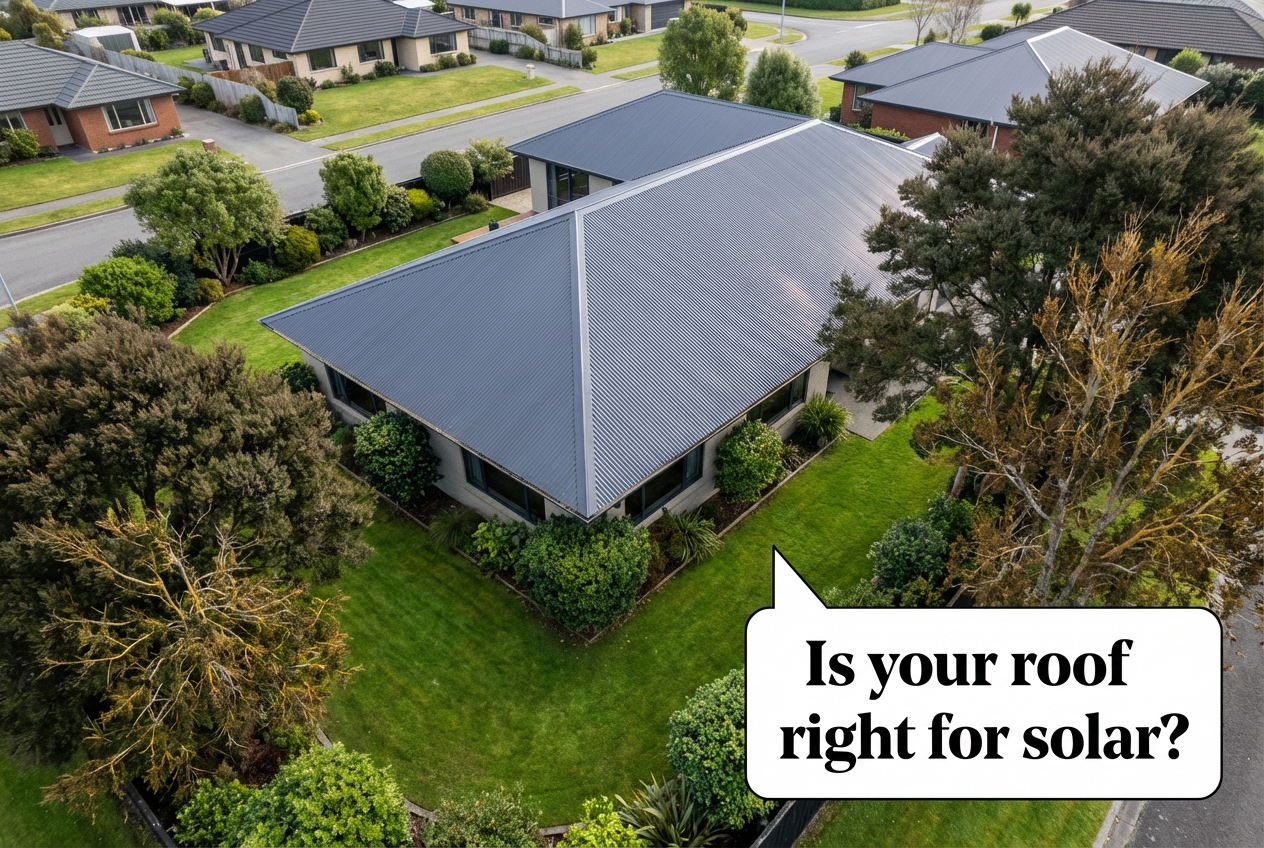
Is My House Suitable for Solar Panels?
Check if your NZ home is right for solar. Roof direction, pitch, shade, and structural factors explained for Kiwi houses.
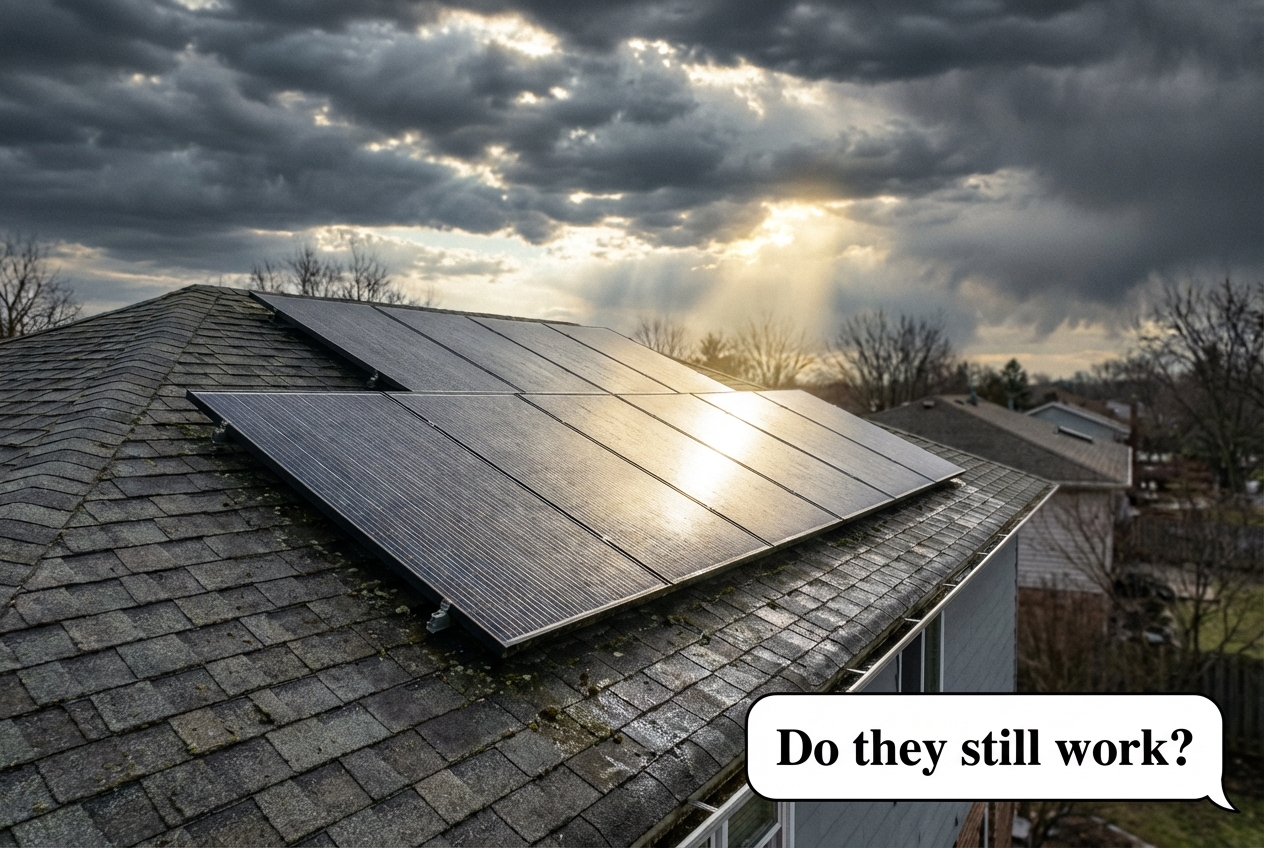
Do Solar Panels Work in Winter and on Cloudy Days in NZ?
Solar panels still generate power on cloudy days and through NZ winters. Here's exactly how much output changes and why it still works.
Solar Panel Costs NZ: What You'll Actually Pay in 2026
Real pricing data for NZ solar in 2026. System costs by size, what affects price, and how to tell if a quote is fair.