
Solar Panels and EV Charging in NZ: The Complete Setup
Key Takeaways
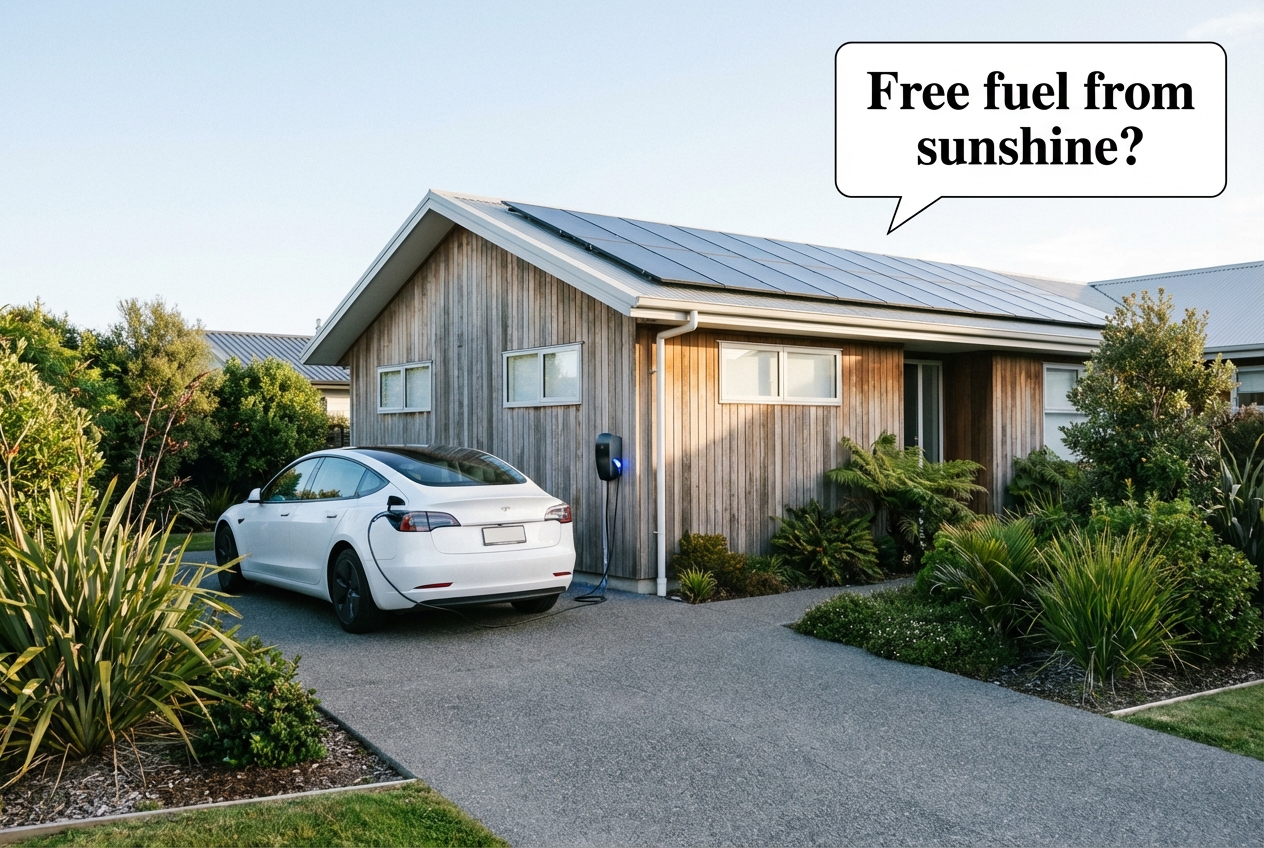
- Free fuel from sunshine: solar-charged driving costs $0.00/km vs $0.15 to $0.20/km for petrol
- Add 2 to 3 kW to your solar system to cover average EV charging needs (about 2,500 to 4,000 kWh/year)
- Smart chargers start at $800: NZ-designed Evnex and Wallbox both offer solar matching built in
- 5 kW of surplus solar can charge 30 to 50 km of driving per day, enough for most Kiwi commutes
- Vehicle-to-Home is coming: use your EV battery to power your house at night. Wallbox Quasar already supports it in NZ
PS We connect you with vetted solar installers across NZ. Answer a few quick questions, get your personalised estimate, and compare quotes from trusted local companies.
Why Solar and EVs Are a Perfect Match
There are 135,348 electric vehicles on New Zealand roads as of the end of 2025, making up about 2.8% of the national fleet. That number is growing fast, and there's a very good reason solar homeowners are leading the charge (pun intended).
Here's the thing about solar power: on a sunny day, your panels often generate more electricity than your house can use. Without an EV, that surplus gets exported to the grid at your buy-back rate, typically 7c to 17c per kWh. Not terrible, but not great either.
But when you plug in an EV, that surplus has somewhere useful to go. Instead of exporting power at 12c and buying petrol at $2.60 a litre, you're using free sunshine to drive. Every kilowatt-hour you put into your car battery saves you the full retail electricity rate (30c to 38c/kWh) or the petrol equivalent, which works out to roughly $0.15 to $0.20 per kilometre.
The economics are genuinely exciting. A typical Kiwi drives about 14,000 km per year. In a petrol car at current fuel prices, that costs $2,100 to $2,800. In an EV charged from solar? Effectively $0. Zero. The fuel bill just disappears.
An EV turns your surplus solar from a 12c/kWh export into a $0.15 to $0.20/km saving. That's where the real return on solar investment lives.
The subsidy landscape has changed
Worth noting: the Clean Car Discount was repealed in December 2023, so there's no government rebate on EV purchases anymore. Road User Charges (RUCs) now apply to EVs at the same rate as petrol vehicles, ending the previous exemption. This means the running cost advantage of EVs now comes down entirely to the energy source, and that's where solar really shines.
Without subsidies propping up the economics, the case for solar-charged EVs is actually clearer than ever. You're not relying on government policy that could change. You're relying on the sun, which tends to be more reliable than politicians.
The Real Cost Per Kilometre
This is where the numbers get really interesting. We've calculated the cost per kilometre for every common charging source, based on typical EV consumption of 15 to 18 kWh per 100 km (which covers most popular EVs in NZ, from the Nissan Leaf to the Tesla Model 3).
| Energy Source | Cost per km | Annual (14,000 km) |
|---|---|---|
| Home solar (free surplus) | ~$0.00 | ~$0 |
| Grid off-peak / night rate | $0.03 to $0.04 | $420 to $560 |
| Grid standard rate | $0.05 to $0.07 | $700 to $980 |
| Public fast charger | $0.08 to $0.12 | $1,120 to $1,680 |
| Petrol equivalent | $0.15 to $0.20 | $2,100 to $2,800 |
Look at the gap between solar and petrol. Even if you only charge from solar half the time and use the grid for the rest, you're still saving $1,500+ per year on fuel compared to a petrol car. Over a 10-year vehicle ownership period, that's $15,000 to $28,000 in fuel savings alone.
And here's what makes this particularly compelling for NZ: our electricity grid is already 80%+ renewable. So even when you're charging from the grid at night, you're mostly using hydro and wind power. Pairing that with your own solar during the day makes your transport almost entirely emissions-free.
How Much Extra Solar Do You Need for an EV?
The average Kiwi drives about 14,000 km per year. A typical EV uses 15 to 18 kWh per 100 km, which means you need roughly 2,100 to 2,520 kWh of extra solar generation per year to cover your driving. In practice, you'll want more than the minimum because not every sunny hour aligns with when your car is plugged in.
The rule of thumb: add 2 to 3 kW to your base solar system size for EV charging.
- Already have a 6.6 kW system? Consider upgrading to 8 to 10 kW
- Planning a new system? Size it at 8 to 10 kW from the start if you own or plan to buy an EV
- The marginal cost of adding extra panels during installation is much cheaper than retrofitting later
The daily maths
On a good solar day, 5 kW of surplus generation (after your house has taken what it needs) can charge roughly 30 to 50 km of driving range. The average NZ commute is about 20 km each way, so 40 km round trip. That means a decent solar surplus covers your daily commute with room to spare on most days.
In winter, you'll generate less solar, so you'll rely more on the grid for overnight charging. That's fine. The strategy isn't to go 100% solar-charged year-round (though in summer you easily can). It's to maximise free solar charging when it's available and use cheap off-peak grid power when it's not.
What about two EVs?
If your household has two EVs (increasingly common), you'll want a larger system. Think 10 to 13 kW of solar capacity. The second EV roughly doubles your transport energy needs, adding another 2,000 to 2,500 kWh per year. The good news is that panel prices per watt drop as system size increases, so the upgrade is proportionally cheaper.
Smart EV Chargers: What to Buy in NZ
You can charge an EV from a standard wall socket, but it's painfully slow (about 10 km of range per hour). A dedicated Level 2 charger is the way to go, and if you have solar, you want one with "solar matching" capability.
Here are the main options available in NZ right now:
| Brand | Type | NZ Price (installed) | Solar Integration |
|---|---|---|---|
| Wallbox Pulsar Max | Level 2 (7.4 kW) | $1,500 to $2,500 | Solar matching via app |
| Evnex | Level 2 (7.4 kW) | $1,200 to $2,000 | NZ-designed, solar matching |
| Smart EV Chargers | Level 2 | $800 to $1,500 | Dynamic load balancing |
| Wallbox Quasar | Bidirectional (V2H) | Premium | Vehicle-to-Home capable |
Installation costs $800 to $1,200 on top of equipment price, depending mainly on the distance from your switchboard to where the charger is mounted. If your garage is right next to the switchboard, you're at the lower end. If the charger needs to go on the other side of the house, expect to pay more for the cable run.
Our pick for most solar households
The Evnex is hard to beat for Kiwi solar homes. It's designed and supported in New Zealand, the solar matching works well, and the price is competitive. Wallbox Pulsar Max is the premium alternative with a slightly more polished app experience. If you're on a tighter budget, Smart EV Chargers get the job done with dynamic load balancing at a lower price point.
Do you even need a smart charger?
Technically, no. You could plug into a standard 15A outlet and manually start charging when the sun is out. But a smart charger with solar matching automates the whole process. It talks to your solar inverter and adjusts charging speed in real time based on how much surplus power is available. Set it and forget it. Given you're already spending $10,000+ on solar and $40,000+ on an EV, the extra $1,000 to $2,000 for a smart charger is a no-brainer.
Solar Matching: How It Works
Solar matching (sometimes called "solar-aware charging" or "excess solar charging") is the feature that makes this whole setup work seamlessly. Here's the process:
- Your solar inverter reports real-time generation to your home network (most modern inverters do this via Wi-Fi)
- Your smart charger monitors the surplus. When generation exceeds household consumption by a set threshold (usually 1.5 kW or more), the charger starts
- Charging speed adjusts dynamically. If a cloud passes over and generation dips, the charger slows down or pauses. When the sun comes back, it ramps up again
- You set a minimum threshold. Most chargers let you set the minimum surplus before charging begins. This prevents the charger from pulling grid power to make up the difference
The result? Your car charges only when you have spare solar power. You never pay for the electricity, and you never export cheap power to the grid when it could be going into your car battery instead.
What you need for solar matching to work
Three things:
- A solar inverter that shares generation data (SolarEdge, Enphase, Fronius, Huawei, and Sungrow all support this)
- A smart EV charger with solar matching capability (Evnex, Wallbox, or similar)
- Both devices on the same Wi-Fi network, or connected via a CT clamp on your main supply
Your installer can set this up during installation. It typically takes 15 to 30 minutes to configure once the hardware is in place.
The Best Time to Charge
With solar matching, the best time to charge is whenever the sun is generating surplus power. But life isn't always that simple. Here's a practical charging strategy that maximises savings:
Tier 1: Solar surplus (free)
This is your primary charging window. Typically 10am to 3pm on sunny days, when solar generation peaks and household consumption is usually low (especially if nobody's home). A smart charger handles this automatically. In summer, you can easily add 30 to 50 km of range per day from solar alone.
Tier 2: Off-peak grid (cheap)
When solar isn't enough (cloudy days, winter, or after a long drive), use off-peak grid power overnight. Most time-of-use plans offer rates of 15c to 20c/kWh between 9pm and 7am. That works out to about $0.03 to $0.04 per kilometre, still a fraction of petrol costs. Smart chargers let you schedule overnight charging for these cheaper windows.
Tier 3: Peak grid (avoid)
Try not to charge during peak grid hours (5pm to 9pm). Electricity rates are highest, and the grid is under the most strain. If you must charge during peak, it still costs less than petrol, but you're leaving money on the table compared to solar or off-peak charging.
The golden rule: solar first, off-peak second, peak grid as a last resort. A smart charger makes this strategy automatic.
Vehicle-to-Home: Using Your Car as a Battery
This is where things get really futuristic. Vehicle-to-Home (V2H) technology lets you use your EV's battery to power your house, not just the other way around. Think of your car as a giant battery on wheels that can feed electricity back into your home when the sun goes down.
A typical EV battery holds 40 to 75 kWh of energy. Even if you only used 20% of that for home backup, that's 8 to 15 kWh of storage, comparable to a Tesla Powerwall. The average NZ household uses about 6 to 8 kWh overnight. So in theory, your car could power your house through the night using energy it stored from your solar panels during the day.
What's available in NZ right now
V2H is still early days in New Zealand, but it's real and it's here:
- Wallbox Quasar: the most established bidirectional charger available in NZ. Works with CHAdeMO-equipped vehicles (Nissan Leaf, Mitsubishi Outlander PHEV)
- Delta: offers V2H-capable chargers that are starting to appear in the NZ market
- CCS bidirectional charging: coming soon. This will open V2H to Tesla, Hyundai, Kia, and most modern EVs using the CCS connector standard
The practical reality
V2H is genuinely promising, but it comes with caveats. The hardware is expensive (premium pricing for bidirectional chargers). It adds extra charge/discharge cycles to your EV battery, which may affect long-term battery degradation. And right now, vehicle compatibility is limited.
Our take: if you're buying a new solar and EV setup today, make sure your wiring and switchboard can support V2H in the future. Don't pay the premium for the bidirectional charger yet unless you specifically need backup power (rural properties, areas with frequent outages). The technology will be cheaper and more widely compatible within 2 to 3 years.
What if You Don't Have Solar Yet?
If you're reading this and thinking "I've got an EV but no solar," or "I'm thinking about getting both," the best advice is simple: bundle the installation.
Getting solar panels and an EV charger installed at the same time saves money in several ways:
- Single electrician visit: one call-out fee, one set of paperwork, one consent process (if needed)
- Shared cable runs: the electrician is already running cables from your switchboard to the roof. Adding a cable to the garage is incremental
- Right-sized from day one: your installer can design the solar system with EV charging factored in, rather than retrofitting a system that was sized only for the house
- Potential package deals: many NZ installers offer combined solar + EV charger packages at a discount
If you already have solar but no EV charger, adding one is straightforward. Your existing installer (or any qualified electrician) can mount and wire a charger in half a day. The key consideration is whether your current solar system is large enough to generate surplus for charging. If you're already exporting a decent amount to the grid, you're golden. If your system barely covers your household needs, you may want to add more panels at the same time.
Timing your purchase
If you're planning to buy an EV in the next 12 to 24 months, size your solar system for it now. Adding 2 to 3 kW of extra capacity during initial installation costs $2,000 to $4,000. Retrofitting those same panels later could cost $3,000 to $6,000 with a second installation visit.
Even before you own an EV, those extra panels earn their keep by exporting to the grid or powering other daytime loads. You won't regret having more solar capacity. You might regret having too little.
The Full Setup Cost Breakdown
Let's put real numbers on the complete solar + EV charging setup. These are NZ prices as of early 2026, including installation.
| Component | Cost Range | Notes |
|---|---|---|
| 8 to 10 kW solar system | $13,000 to $22,000 | Sized for house + EV charging |
| Smart EV charger (equipment) | $800 to $2,500 | Evnex, Wallbox, or Smart EV Chargers |
| EV charger installation | $800 to $1,200 | Depends on distance to switchboard |
| Battery (optional) | $9,000 to $24,000 | Not required but extends solar use |
| Total (solar + EV charger) | $14,600 to $25,700 | Without battery |
| Total (with battery) | $23,600 to $49,700 | Full setup |
For most households, the solar + EV charger combination (without a battery) offers the best return on investment. You're looking at $14,600 to $25,700 total, with annual savings of $2,500 to $4,000 when you factor in both electricity and fuel savings. That puts your payback period at roughly 5 to 8 years.
Financing options
Several NZ banks offer green loans specifically for solar and EV charging installations. Rates start from 0% to 1% through programmes like Westpac's Warm Up loan or Kiwibank's Sustainable Energy Loan. These make the upfront cost much more manageable, and the monthly loan repayments are often less than what you save on power and fuel.
Check our solar grants and incentives guide for the full list of financing options and any current programmes.
What to Do Next
Ready to set up solar + EV charging at your place? Here's the practical path forward:
- Figure out your numbers. Grab your last 12 months of power bills and check your annual driving distance. This tells an installer exactly how to size your system
- Check your roof situation. Open Google Maps, find your house, and see how much north-facing roof space you have. You need roughly 16 to 20 square metres for an 8 to 10 kW system
- Think about where the charger goes. Ideally in a garage or carport, close to your switchboard. Measure the distance if you can, as this affects installation cost
- Get 2 to 3 quotes from SEANZ-accredited installers who do both solar and EV charger installation. Make sure they include solar matching setup in the quote
- Ask about future-proofing. Even if you're not buying a V2H charger now, ask your electrician to run cabling that supports a future upgrade
Or start with our free solar survey. It takes about 2 minutes, factors in your EV charging needs, and gives you a personalised estimate. No obligation, no pressure.
Frequently Asked Questions
Can I charge my EV entirely from solar?
In summer, absolutely. A well-sized system (8 to 10 kW) with solar matching will cover most or all of your daily charging needs from October to March. In winter, you'll supplement with grid power overnight. Across the full year, a typical solar + EV setup covers 60% to 80% of charging from solar, with the rest coming from cheap off-peak grid power.
How long does it take to charge an EV from solar?
A 7.4 kW Level 2 charger running on solar surplus can add about 40 km of range per hour. On a good solar day with 5+ hours of surplus generation, you could add 150 to 200 km of range. For daily commuting (40 km round trip), you typically need just 1 to 2 hours of solar charging. The smart charger handles it automatically while you're at work or out running errands.
Do I need a battery as well as an EV charger?
No, a battery is optional. Your EV and a smart charger work perfectly well with solar alone. The EV battery itself acts as energy storage, soaking up surplus solar during the day. A home battery (like a Tesla Powerwall) adds value by storing solar for evening household use, but it's not required for solar EV charging. If budget is limited, prioritise the solar system and smart charger first.
What happens if my solar isn't generating enough to charge?
A good smart charger handles this gracefully. When solar surplus drops below the minimum threshold (usually 1.5 kW), the charger pauses automatically. It resumes when surplus returns. For topping up outside solar hours, you can schedule overnight charging at off-peak rates ($0.03 to $0.04/km). The charger manages both modes, no manual switching needed.
Will charging an EV overload my home electrical system?
Unlikely, but it depends on your existing setup. A 7.4 kW charger draws about 32 amps on a single phase. Most modern NZ homes have 63A or 80A main breakers, which comfortably support an EV charger alongside normal household loads. Smart chargers with dynamic load balancing automatically reduce charging speed if your home consumption spikes, preventing overload. Your electrician will assess your switchboard capacity during installation.
Can I charge at home with a standard wall socket?
Yes, but it's slow. A standard 10A socket delivers about 2.3 kW, adding roughly 10 to 12 km of range per hour. That's fine for overnight top-ups if you drive short distances, but a dedicated 7.4 kW charger is 3x faster and much better suited to solar matching (it can ramp up and down with your solar generation). For safety, never use extension leads for EV charging.
What's the best EV for solar charging in NZ?
Any EV works with solar charging. The "best" depends on your budget and needs. For maximum solar utilisation, EVs with slower onboard chargers (like the Nissan Leaf at 6.6 kW) are actually well-matched to typical residential solar surplus. For V2H capability, the Nissan Leaf and Mitsubishi Outlander PHEV currently have the best support via CHAdeMO. Tesla and other CCS vehicles will gain V2H support as bidirectional CCS chargers become available.
How much does Road User Charges (RUC) cost for EVs?
Since April 2024, EVs pay the same RUC rate as petrol vehicles: $76 per 1,000 km. For 14,000 km per year, that's about $1,064 annually. This is a real cost to factor in, but even with RUC, the total cost of running a solar-charged EV is dramatically lower than a petrol vehicle. Your fuel is free (solar) and servicing costs are lower (fewer moving parts, no oil changes). The RUC cost is the same whether you charge from solar or the grid, so it doesn't change the solar vs grid comparison.
Written by Sarah Chen
Sarah has spent three years covering renewable energy in New Zealand, from residential rooftop systems to community solar projects. She holds a degree in Environmental Science from the University of Auckland.
Reviewed by
Matt Wilson
Registered Electrician & Solar Installer
Related guides
View all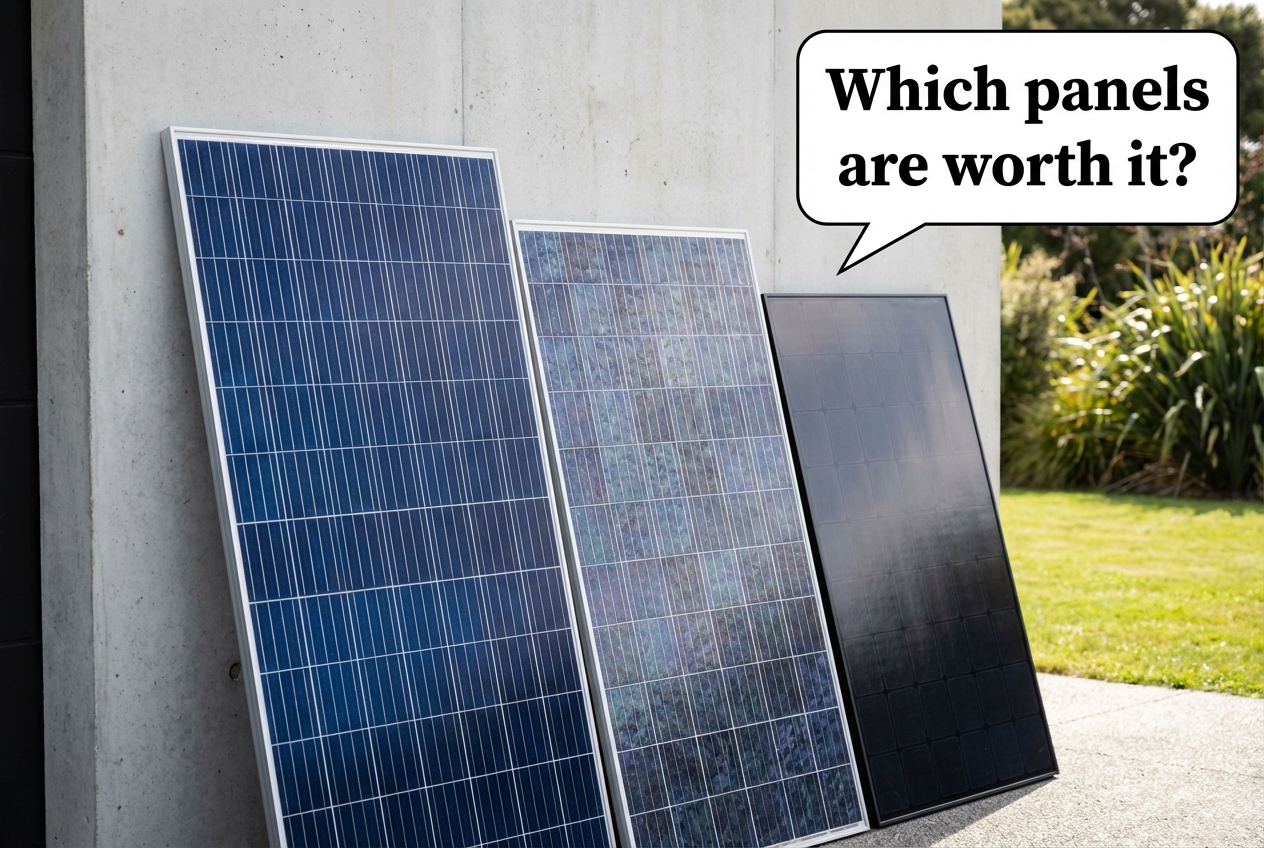
Best Solar Panels NZ: Brands, Tiers and What to Look For (2026)
Compare the best solar panels available in NZ. Tier 1 brands, specs, warranties, NZ pricing, and what installers actually use. TOPCon vs PERC vs HJT explained.
How Many Solar Panels Do I Need?
Work out how many solar panels your NZ home needs. Based on your power usage, roof space, and whether you're adding a battery or EV charger.

Is My House Suitable for Solar Panels?
Check if your NZ home is right for solar. Roof direction, pitch, shade, and structural factors explained for Kiwi houses.
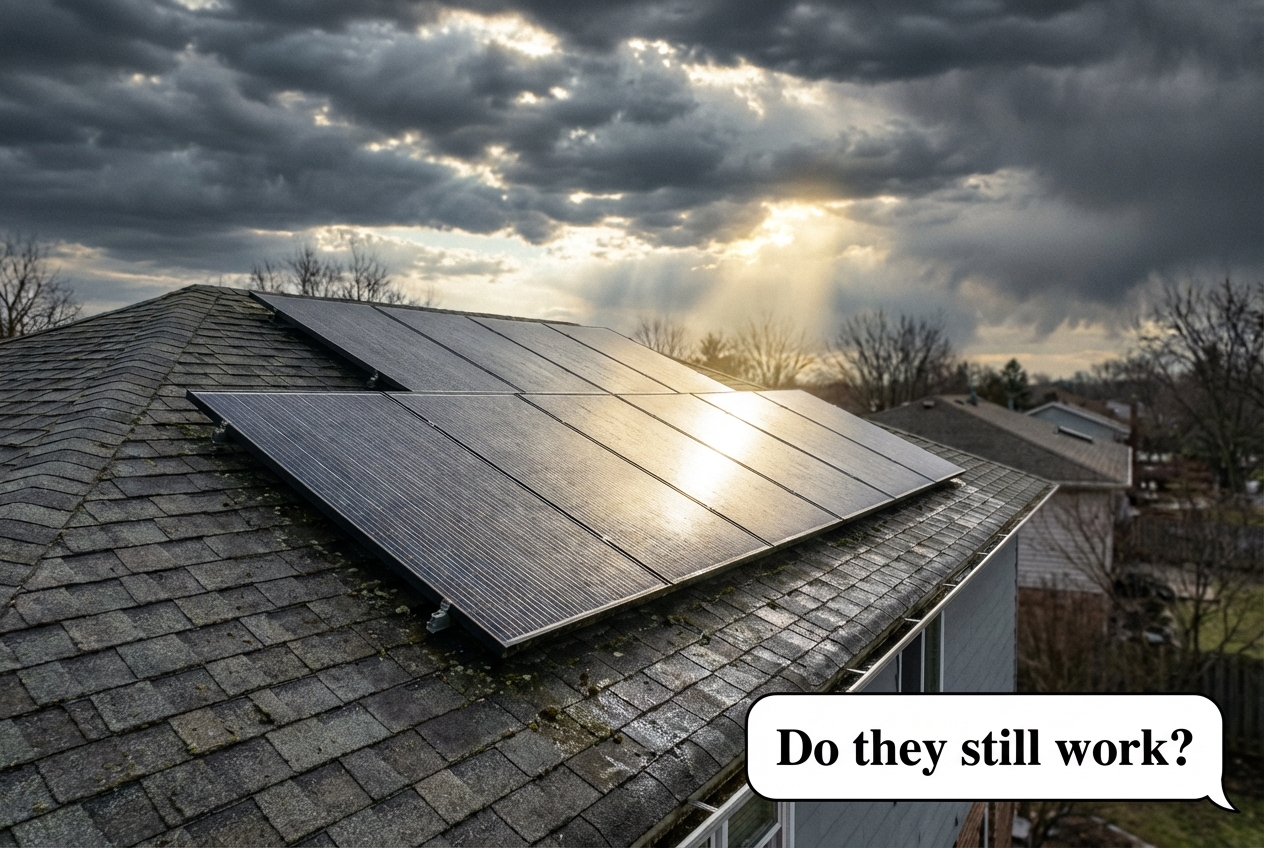
Do Solar Panels Work in Winter and on Cloudy Days in NZ?
Solar panels still generate power on cloudy days and through NZ winters. Here's exactly how much output changes and why it still works.