
Do Solar Panels Work in Winter and on Cloudy Days in NZ?
Key Takeaways
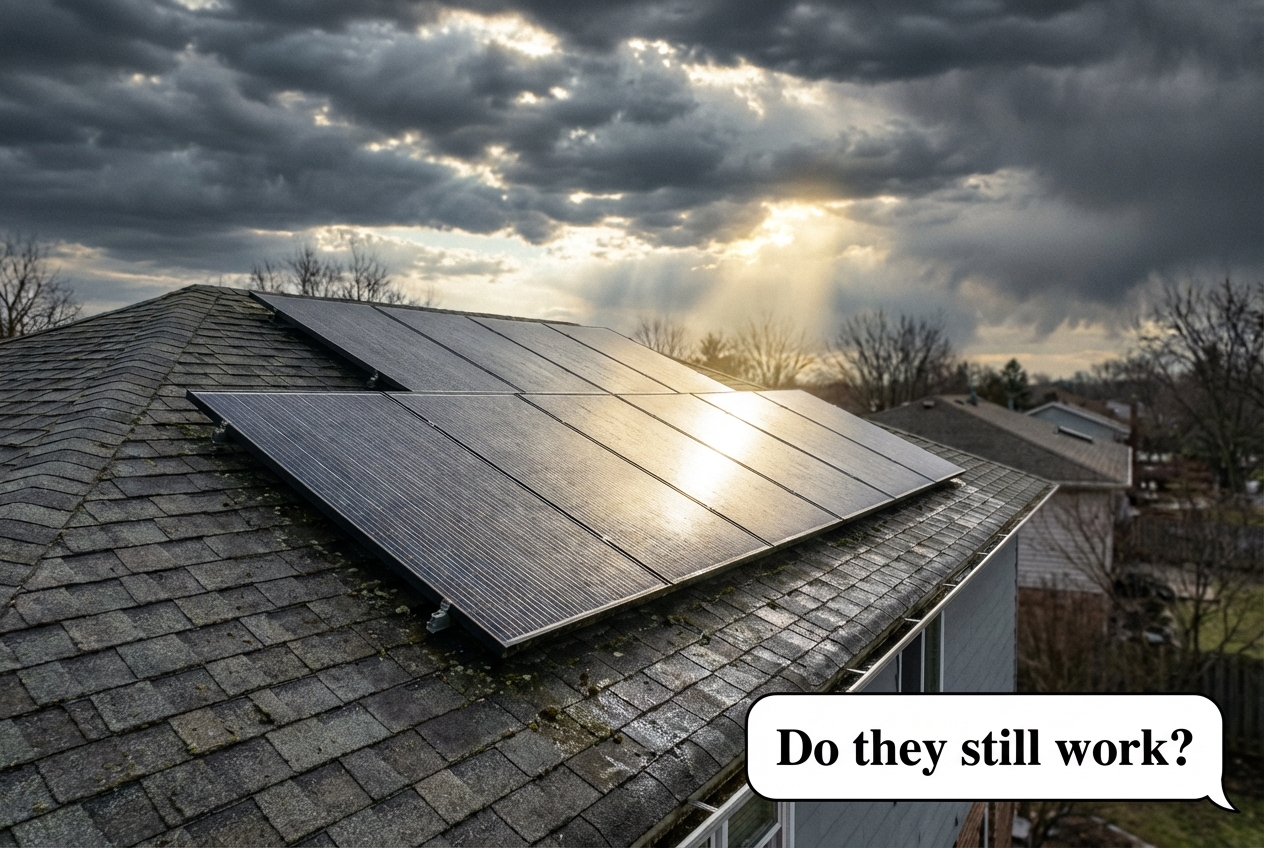
- Solar panels work on light, not heat. They produce electricity year-round in every NZ region.
- Winter output drops 50 to 60% compared to summer, but panels still generate 15 to 25 kWh per day (10kW system).
- On overcast days, expect 10 to 25% of rated output. Panels never fully stop during daylight.
- Cold temperatures actually improve panel efficiency. A crisp winter morning can outperform a hot summer afternoon.
- Every NZ region gets more solar irradiance than Germany, the world’s 4th largest solar market.
PS We connect you with vetted solar installers across NZ. Answer a few quick questions, get your personalised estimate, and compare quotes from trusted local companies.
The Short Answer
Yes, solar panels absolutely work in winter and on cloudy days in New Zealand. They produce less than in summer, but they never stop generating electricity during daylight hours.
This is the single biggest misconception we hear from Kiwi homeowners considering solar. People assume panels need blazing hot sunshine to work. They don’t. Solar panels convert light into electricity, and there is plenty of light in a New Zealand winter, even on an overcast day in Wellington.
The real question is not whether panels work in winter. It’s whether the reduction in output changes the financial case for solar. And for most households, the answer is no. Solar systems are sized for annual production, not daily. Your summer surplus more than compensates for the winter dip.
Solar panels produce electricity from light, not heat. A cold, clear winter day can actually be more efficient than a scorching summer afternoon.
Let’s look at the actual numbers so you know exactly what to expect through an NZ winter.
How Much Less Do Panels Produce in Winter?
There is no point pretending winter output is the same as summer. It’s not. Here’s a realistic comparison for the North Island.
| Factor | Summer | Winter | Difference |
|---|---|---|---|
| Peak sun hours | 5 to 6 hrs/day (North Island) | 2 to 3 hrs/day | ~50-60% less |
| 10kW system daily output | ~60 kWh/day | ~15 to 25 kWh/day | ~60-75% less |
| Daylight hours | 14 to 15 hrs | 9 to 10 hrs | 4 to 5 fewer hours |
| Panel efficiency | Slightly lower (heat) | Slightly higher (cool) | +0.5% per °C below 25°C |
So yes, you’re looking at roughly half to two-thirds less production in winter compared to summer. That sounds dramatic on its own, but context matters. A 10kW system producing 15 to 25 kWh per day in winter still covers a significant chunk of a typical household’s daily electricity use (around 20 to 25 kWh for an average NZ home).
The South Island sees slightly lower winter output than the North Island due to fewer daylight hours and lower sun angles, but Canterbury’s clear, cold days often outperform cloudy Auckland ones. Geography matters, but not as much as you might think.
What does a winter day actually look like?
On a typical winter day in Auckland, your panels will start generating around 7:30am and stop around 5:00pm. Peak production happens between 10am and 2pm. You will not see the long, high-output plateau you get on a January afternoon. Instead, think of a gentle bell curve with a lower peak.
For a 6.6kW system (the most popular residential size in NZ), expect around 12 to 18 kWh on a clear winter day. On an overcast winter day, that might drop to 5 to 10 kWh. On a heavily overcast, rainy day, you might get 2 to 5 kWh.
None of these numbers are zero. Your panels are always working during daylight.
What About Cloudy Days?
This is the other big concern. New Zealand is not exactly known for wall-to-wall sunshine, especially from May through August. So what happens when clouds roll in?
Solar panels respond to the full spectrum of visible light, not just direct sunlight. When it’s overcast, something called diffuse radiation still reaches your panels. This is sunlight that has been scattered by clouds and atmosphere. It’s less intense than direct sunlight, but it’s very much there.
Realistic cloudy-day output
- Light cloud cover: 40 to 60% of rated output. You might not even notice the difference on your monitoring app.
- Moderate overcast: 20 to 40% of rated output. Panels are clearly producing less, but still contributing meaningfully.
- Heavy overcast / rain: 10 to 25% of rated output. Production is low but not zero.
- Thick storm cloud: 5 to 15% of rated output. Even during a proper downpour, a small amount of electricity is still being generated.
Here’s something most people don’t realise: New Zealand’s UV index stays moderate even on cloudy days. That is why you can still get sunburnt through clouds here. The same principle applies to solar panels. UV and visible light penetrate cloud cover much more effectively than most people expect.
If there is enough light outside to read a book, your solar panels are generating electricity.
Rain actually has a silver lining (no pun intended). It keeps your panels clean. Dust, pollen, bird droppings, and salt spray all reduce panel efficiency by blocking light. A good downpour washes all of that away, so your panels often perform better on the clear day after rain than they did before the rain came.
Why Cold Weather is Actually Good for Panels
This is the part that surprises people. Solar panels are electronic devices, and like all electronics, they perform better when they are cool.
Every solar panel has a rated output, measured under Standard Test Conditions (STC) at 25°C. When a panel gets hotter than 25°C, its efficiency drops. When it gets cooler, efficiency goes up. The typical temperature coefficient for a modern panel is around -0.3% to -0.4% per degree above 25°C.
Flip that around: for every degree below 25°C, your panels gain roughly 0.3 to 0.5% efficiency. On a crisp 5°C winter morning with clear skies, your panels could be running 6 to 10% more efficiently than they would on a 35°C summer afternoon.
Temperature vs. Efficiency
- At 35°C (hot summer day): panels lose 3 to 4% efficiency below their rated output
- At 25°C (rated conditions): panels perform at exactly their rated output
- At 5°C (cold winter morning): panels gain 6 to 10% efficiency above their rated output
Of course, winter’s shorter days and lower sun angle still mean less total energy per day. The efficiency boost does not fully cancel out the reduced sunlight hours. But it does narrow the gap, and it means those crisp, clear winter days are surprisingly productive.
Think of it this way: winter gives you fewer hours of sunlight, but each hour of clear winter sunlight can be more efficient than the same hour on a sweltering February afternoon.
NZ Sunshine by Region
Not all of New Zealand gets the same amount of sunshine. If you live in Nelson, you are in one of the sunniest spots in the country. If you are in Invercargill, you get less sun. But, as we will show in the next section, even Invercargill beats many of the world’s leading solar markets.
Here is a breakdown of annual sunshine hours by region, based on NIWA climate data.
| Region | Annual Sunshine Hours | Solar Rating |
|---|---|---|
| Nelson / Blenheim | 2,400 to 2,500 | Excellent |
| Bay of Plenty | 2,300 to 2,400 | Excellent |
| Hawke's Bay | 2,200 to 2,300 | Very Good |
| Auckland | 2,000 to 2,100 | Good |
| Canterbury | 1,900 to 2,100 | Good |
| Wellington | 1,800 to 2,000 | Moderate |
| Dunedin | 1,600 to 1,700 | Moderate |
| Invercargill | 1,500 to 1,600 | Lower |
Nelson and Blenheim consistently top the sunshine charts, which is why the top of the South Island is often called the “sunshine capital” of New Zealand. But even regions rated as “Moderate” receive enough solar radiation to make residential solar panels financially worthwhile.
Your region affects your expected annual output, which in turn affects your payback period. A system in Nelson will pay for itself faster than the same system in Dunedin. But both will pay for themselves, just on slightly different timelines.
The Germany Comparison
Here is a fact that puts everything into perspective: every single region in New Zealand receives more annual solar irradiance than Germany.
Germany is the world’s 4th largest solar market. They have over 80 gigawatts of installed solar capacity. German homeowners have been installing solar panels for decades, and the economics clearly work there. If solar makes sense in Berlin (which gets around 1,600 sunshine hours per year), it absolutely makes sense in Auckland, Christchurch, or even Invercargill.
NZ vs Germany: Sunshine Hours
- Germany (average): ~1,500 to 1,600 sunshine hours per year
- Invercargill (NZ’s least sunny city): 1,500 to 1,600 sunshine hours per year
- Auckland: 2,000 to 2,100 sunshine hours per year (30% more than Germany)
- Nelson: 2,400 to 2,500 sunshine hours per year (56% more than Germany)
The key takeaway: if you have been hesitating because you think NZ is “too cloudy” or “too far south” for solar, the data simply does not support that. The 4th largest solar market in the world operates with the same or less sunshine than our cloudiest, most southern city.
Beyond sunshine hours, NZ also benefits from relatively clean air (less atmospheric haze reduces light reaching panels in polluted regions) and moderate humidity. These factors mean our actual solar energy yield per sunshine hour is often higher than equivalent locations in Europe.
Why Annual Output Matters More Than Daily
When people worry about winter solar performance, they are usually thinking day by day. That is the wrong frame. Solar economics work on an annual cycle, much like a savings account.
The savings account analogy
Think of your solar production like a bank account. In summer, you are making big deposits. Your panels over-produce relative to what you use, and the excess gets exported to the grid. Your power company pays you a buy-back rate for that surplus (typically 7 to 17 cents per kWh, depending on your retailer).
In winter, you are making smaller deposits and bigger withdrawals. Your panels produce less, and you draw more from the grid. But the credits you built up over summer offset the extra grid costs in winter.
Over a full 12-month cycle, the numbers balance out. That is exactly how solar installers size your system. They calculate your annual electricity consumption, estimate your annual solar production, and design a system where those two numbers are well matched.
How the seasonal balance works in practice
- October to March (summer): Your system over-produces. Excess goes to the grid. You build up credits or receive buy-back payments.
- April to September (winter): Your system under-produces. You draw more from the grid. Your power bill is higher than summer, but lower than it was before solar.
- Annual net position: Total solar production offsets 60 to 90% of your annual electricity bill (depending on system size and usage patterns).
The important thing is that your annual savings are what matter. A system that saves you $2,000 per year does not need to save you exactly $167 every month. Some months will be higher, some lower. Over the year, the total is what counts.
Tips to Maximise Winter Production
While you can not change the weather, there are practical steps to squeeze the most out of your panels during the shorter, darker months.
[1] 1. Keep your panels clean
Rain does a decent job of washing panels naturally, but winter also brings moss, lichen, and algae growth, especially in humid regions like the West Coast, Waikato, and Northland. A buildup of organic material on your panels can reduce output by 5 to 15%.
Check your panels visually a couple of times through winter. If they look grimy, a gentle hose-down from the ground is usually enough. Never use a pressure washer or abrasive cleaning products.
[2] 2. Get your tilt angle right
Tilt angle matters more in winter than summer. In summer, the sun is high in the sky and panels at almost any angle will catch plenty of light. In winter, the sun sits lower on the horizon, and a steeper tilt catches significantly more of that low-angle sunlight.
Most NZ roofs have a pitch of 15 to 25 degrees. The optimal year-round angle for NZ is roughly equal to your latitude (35 to 45 degrees for most of the country). If your roof pitch is shallow, your winter output will be lower than it could be with a steeper setup. This is something to discuss with your installer during the design phase.
[3] 3. Manage shade from trees
Deciduous trees that lose their leaves in winter are less of a problem than you might think, but if you have evergreen trees or buildings casting shadows on your panels during winter’s lower sun angle, the impact can be significant.
Even partial shading on a string inverter system can drag down the output of an entire string. If shading is a concern, talk to your installer about microinverters or power optimisers, which allow each panel to operate independently.
[4] 4. Let frost clear naturally
On frosty mornings, your panels will be covered in a thin layer of ice. Do not try to scrape it off or pour warm water on them. The dark surface of the panel absorbs sunlight and clears frost quickly, usually within 30 to 60 minutes of sunrise. Once clear, those cold panels operate at peak efficiency.
[5] 5. Shift heavy electricity use to midday
In winter, your peak solar production window is narrower, roughly 10am to 2pm. If you can run your dishwasher, washing machine, or heat pump during this window, you use more of your own solar power directly instead of drawing from the grid in the evening. Timer switches and smart plugs make this easy to automate.
Do You Need More Panels to Compensate for Winter?
We get asked this a lot, and the answer is almost always no.
Here’s why: if you oversize your system for winter, you end up with a system that massively over-produces in summer. That surplus gets exported to the grid, but NZ buy-back rates (7 to 17c/kWh) are much lower than what you pay for imported power (25 to 35c/kWh). So you are essentially selling cheap and buying expensive.
The financially optimal approach is to size your system based on your annual consumption, not your worst-case winter month. A well-designed system covers 70 to 90% of your annual electricity needs. In summer, you will export surplus. In winter, you will draw from the grid. Over the year, the numbers work.
When Extra Panels Might Make Sense
- You are planning to add an EV charger or battery storage in the near future
- Your roof space can accommodate extra panels at minimal additional cost
- You are on a time-of-use plan that pays well for peak exports
- Your buy-back rate is close to your import rate (some plans offer this)
If you do decide to go slightly larger, the marginal cost of adding one or two extra panels during installation is relatively low ($400 to $800 per panel). The expensive part of a solar install is the inverter, mounting, scaffolding, and labour. Once the crew is on your roof, an extra panel or two adds minimal time and cost.
What to Do Next
If you have been holding off on solar because of winter concerns, hopefully the numbers above have put those to rest. Solar works year-round in New Zealand, in every region, even on cloudy days. The winter dip is real but manageable, and it does not change the overall financial case.
The best next step is to find out what a system would actually look like for your home. Every roof is different, and the only way to get accurate numbers is with a site-specific assessment.
Our free solar survey takes about 60 seconds. You tell us about your home and power bill, and we match you with vetted local installers who will provide tailored quotes. No obligation, no pressure, just real numbers for your roof.
Frequently Asked Questions
Do solar panels work on cloudy days in New Zealand?
Yes. Solar panels generate electricity from light, not direct sunlight. On an overcast day in NZ you can expect 10 to 25% of their rated output. Even heavy cloud cover lets diffuse radiation through, so your panels never fully stop producing during daylight hours.
How much do solar panels produce in winter in NZ?
A typical 10kW system produces around 15 to 25 kWh per day in winter, compared to roughly 60 kWh per day in summer. That is a 50 to 60% reduction. However, panels are sized for annual production, and summer surplus compensates for the winter dip.
Do solar panels work with frost or snow?
Frost burns off quickly once sunlight hits the panels, usually within 30 to 60 minutes. Snow is rare on most NZ rooftops, but if it does settle, the dark surface of solar panels warms and clears snow faster than the surrounding roof. A steeper tilt angle also helps snow slide off.
Is solar worth it in the South Island?
Absolutely. Even Invercargill, the least sunny major NZ city, receives more annual solar irradiance than Germany, the world's 4th largest solar market. Canterbury gets very good sunshine hours (1,900 to 2,100 per year), and the cooler temperatures actually boost panel efficiency.
Do I need a battery to get through winter?
Not necessarily. Most NZ solar homes stay connected to the grid and draw power from it when solar production is low. A battery can help you use more of your own solar power in the evenings, but it is not required to make solar work in winter. The grid acts as your backup.
Should I get more panels to compensate for winter?
In most cases, no. Solar systems are designed around annual production. Over-sizing for winter means you will massively over-produce in summer with nowhere useful to send the excess. It is better to size for your annual consumption and let the seasonal balance work itself out.
What is the best panel angle for winter production?
A steeper tilt angle (around 35 to 45 degrees) catches more of the low winter sun. Most NZ roofs sit at 15 to 25 degrees, which is a good year-round compromise. Adjustable tilt systems exist but add cost and complexity, so most homeowners stick with their existing roof pitch.
Written by Sarah Chen
Sarah has spent three years covering renewable energy in New Zealand, from residential rooftop systems to community solar projects. She holds a degree in Environmental Science from the University of Auckland.
Reviewed by
Matt Wilson
Registered Electrician & Solar Installer
Related guides
View all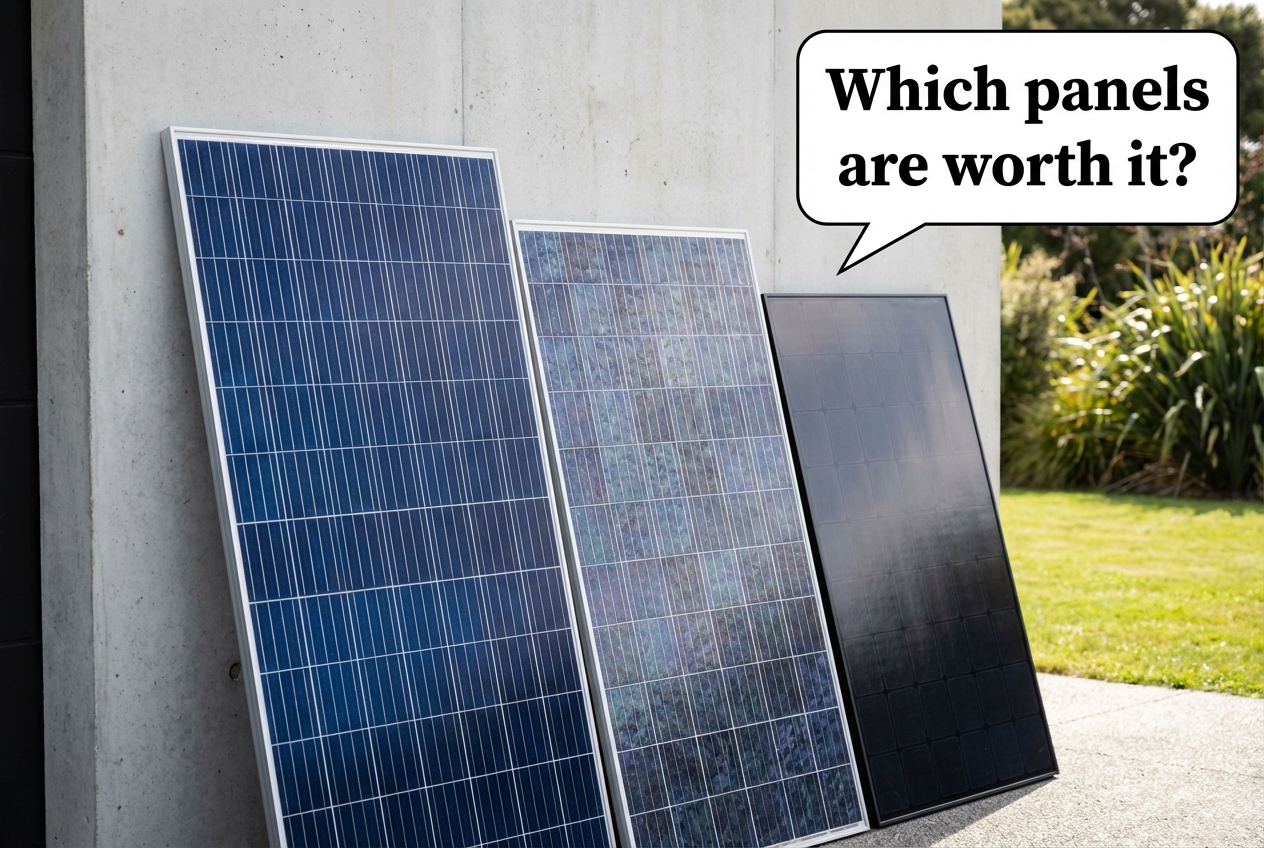
Best Solar Panels NZ: Brands, Tiers and What to Look For (2026)
Compare the best solar panels available in NZ. Tier 1 brands, specs, warranties, NZ pricing, and what installers actually use. TOPCon vs PERC vs HJT explained.
How Many Solar Panels Do I Need?
Work out how many solar panels your NZ home needs. Based on your power usage, roof space, and whether you're adding a battery or EV charger.
Is My House Suitable for Solar Panels?
Check if your NZ home is right for solar. Roof direction, pitch, shade, and structural factors explained for Kiwi houses.
Solar Panel Costs NZ: What You'll Actually Pay in 2026
Real pricing data for NZ solar in 2026. System costs by size, what affects price, and how to tell if a quote is fair.